In this article
A small, real body of research has tested specific AI-enabled tasks and chatbot answers for ADHD-related use cases — from a VR companion during a task to model responses to a fixed question set. As of 2026, most evidence is small-sample and early-stage: nothing on this page is a clinical treatment claim, and the honest read of the field is “promising and unproven,” not “settled.”
This page tracks what’s actually been published, with links, so anyone citing this space — a journalist, a coach, another blogger — can check the primary source instead of taking a claim on faith. It complements the setup and technique guides on the AI for ADHD hub, which covers how to use these tools; this page covers what the research says about whether and how well they actually work.
This is a selected evidence guide, not a systematic review or clinical recommendation. Some summaries use the authors’ abstracts; full-text sources are linked where available. The studies examine different tools and populations, so their results cannot be pooled into a single verdict on ChatGPT or our products.
The evidence in one table
| Study | Year | Who and N | What they tested | What they found | Link |
|---|---|---|---|---|---|
| Han, Xing & Zhou, PLOS ONE | 2026 | Comparative eval, 90 AI responses (30 each from ChatGPT 5, DeepSeek V3, Grok 4) | Accuracy and readability of three LLMs answering ADHD education prompts | All three aligned with DSM-5 content, but all exceeded recommended public-health reading levels; Grok 4 was most consistent, DeepSeek V3 most variable | PLOS ONE |
| Bilgiç et al., BMC Psychiatry | 2026 | 22 ADHD-related questions, scored by 2 child/adolescent psychiatrists, across 3 chatbots | Accuracy and depth of ChatGPT, Gemini, and DeepSeek R1 answering parent-style ADHD questions | High accuracy (87–91%) on that question set, but models varied in depth and clinical usefulness; authors said answers shouldn’t replace clinical evaluation | BMC Psychiatry |
| Ara et al., preprint | 2025 | N=12 adults, VR task, 3 conditions (alone, human double, AI double) | Whether a virtual AI body double changes task completion versus working alone or with a human | Faster completion and greater perceived accuracy and sustained attention with either double versus alone; preference for human vs. AI double diverged by participant | arXiv |
| Zhu et al., preprint | 2025 | N=441 narrative-writing samples (352 train / 89 validation) | Whether an LLM-plus-machine-learning ensemble can detect ADHD from personal narrative text | F1 score of 0.71 (95% CI 0.60–0.80) for the ensemble — better recall than any single model alone, still far from diagnostic-grade | arXiv |
| Cañadas, Maestu & de Ramon, J Clin Med | 2025 | Trial protocol only, planned N=104 adults (52/arm) | Study design (not yet results) for an AI-based cognitive stimulation program (Sincrolab Adults) vs. treatment-as-usual | No outcome data — this is a published protocol; primary outcome is change on the MOXO Continuous Performance Test | PMC |
| Hao et al., JMIR | 2026 | Network meta-analysis, 32 RCTs, 2,819 children/adolescents (ages 4–17) | Ranked digital therapeutics, including AI-integrated cognitive-motor dual-task tools, against each other for ADHD symptoms and executive function | AI-integrated dual-task tools ranked highest, but risk of bias and differences between trials limit certainty and generalization; this is not a chatbot study | JMIR |
| Bergmann et al., J Psychiatric Research | 2026 | N=77 adults, single-blind randomized crossover trial | A digital cognitive-training app (NeuroNation MED) vs. treatment-as-usual | Improved self-rated quality of life and perceived cognition; no significant change on objective neuropsychological tests or ADHD characteristics | Europe PMC |
| Selaskowski et al., BJPsych Open | 2023 | N=40 randomized adults (34 completed, 17 per arm) | Chatbot-delivered vs. app-delivered self-guided psychoeducation for adult ADHD | Both formats reduced ADHD core symptoms; neither format beat the other | Cambridge Core |
| Dahò & Caci, BMC Psychology | 2025 | 27 neuropsychology and rehabilitation specialists reviewed ChatGPT-generated plans | Whether ChatGPT-drafted executive-function rehab plans for ADHD hold up under expert review | Experts liked the theoretical consistency, especially for adolescents and adults, but flagged weak personalization and unvalidated techniques | Europe PMC |
| Chen, Meng & Nie, preprint | 2026 | N=42 adults with ADHD (22 interviews, 20 in a design study) | What adults with ADHD actually need from AI tools for task management, via interviews and a speed-dating design study | Task management is relational and affective, not a solo willpower problem — argues AI tools should support co-regulation, not just reminders | arXiv |
What this means for a person with ADHD
One fixed-question evaluation found high answer accuracy, with important limits. In the BMC Psychiatry study, ChatGPT, Gemini, and DeepSeek R1 scored 87–91% across the study’s 22 ADHD-related questions; the PLOS ONE evaluation found DSM-5-aligned content in its tested responses, while both lines of work also found variation in depth or readability. Those results describe the tested prompts and models, not every chatbot or every ADHD question. Treat a chatbot answer as a reasonable starting point, not a diagnosis, and not a reason to skip a clinician for anything that matters.
The “AI as company while I work” idea has small, real support — and a caveat. The VR body-doubling study found people worked faster and reported greater accuracy and sustained attention with either a human or an AI double than alone, which lines up with what our own body-doubling protocol is built around. The caveat: that study tested a virtual-reality companion in a headset, not a chatbot in a text window, so it is not evidence that a consumer chatbot improves ADHD outcomes. The result does not establish that the mechanism transfers to “talking to ChatGPT while you do the dishes.”
“Does it actually build a skill or just prop me up” barely has an answer yet. Only two of the adult studies above tested an actual intervention against a control group over time — the chatbot-psychoeducation trial and the digital cognitive-training trial — and both came back mixed: symptoms improved about as much as a non-chatbot comparison, or subjective ratings improved while objective test scores didn’t move. That’s not a failure, it’s an early field. If you’re deciding whether to lean on AI for a given task, the rent-versus-build framing is a more useful lens right now than waiting for research to settle it, because the research hasn’t.
What the research has not shown yet
In the studies summarized here, no general-purpose AI chatbot was tested for ADHD symptom effects over a period longer than a few weeks — the longest controlled trial above ran 12 weeks, and that one used a dedicated training app, not a general chatbot. The studies summarized here also do not establish how a general-purpose assistant compares directly with stimulant medication or established therapy for core ADHD symptoms, how results vary by ADHD presentation or product, or what happens after someone stops using the tool. None of that means AI tools don’t help with those things. It means those questions are not established by the studies summarized here, which is a different, narrower claim than “it doesn’t work.”
How to read an AI-and-ADHD claim
Most “AI helps with ADHD” claims you’ll see online cite no study at all. When one does cite something, run it through this before you believe it:
- What was N? A study of 12 or 22 people is a real signal worth reading, not proof of anything at population scale. The studies above range from 12 to 2,819 — check which end of that range the claim you’re reading is standing on.
- What was the design? A randomized controlled trial with a comparison group means something different from a protocol paper describing a trial that hasn’t run yet, which means something different again from an expert-review or interview study. All three are legitimate research; they don’t all answer the same question.
- Who funded it, and who built the tool being tested? A company-funded study of its own app is not automatically wrong, but it’s a fact worth knowing before you weigh the result.
- Did it study “AI” in general, or one specific product? A finding about a purpose-built cognitive-training app doesn’t transfer to “ChatGPT helps with ADHD,” and a finding about ChatGPT doesn’t transfer to every chatbot. Precision here is where most bad claims fall apart.
- Were the outcomes self-reported or objectively measured? Several studies above found self-reported improvement without a matching change on an objective test — both numbers are real data, but they’re not the same claim, and a headline that blurs them is doing you a disservice.
None of this is a reason to distrust every claim about AI and ADHD. It’s the difference between reading the abstract and reading the headline that summarized the abstract for clicks.
Worth saying plainly, since this whole page is about tools, not treatment: none of what’s above is a substitute for professional ADHD treatment, and nothing here is medical advice. If you’re managing a diagnosis, a clinician is the right person to weigh in on that — these are productivity tools, evaluated as productivity tools.
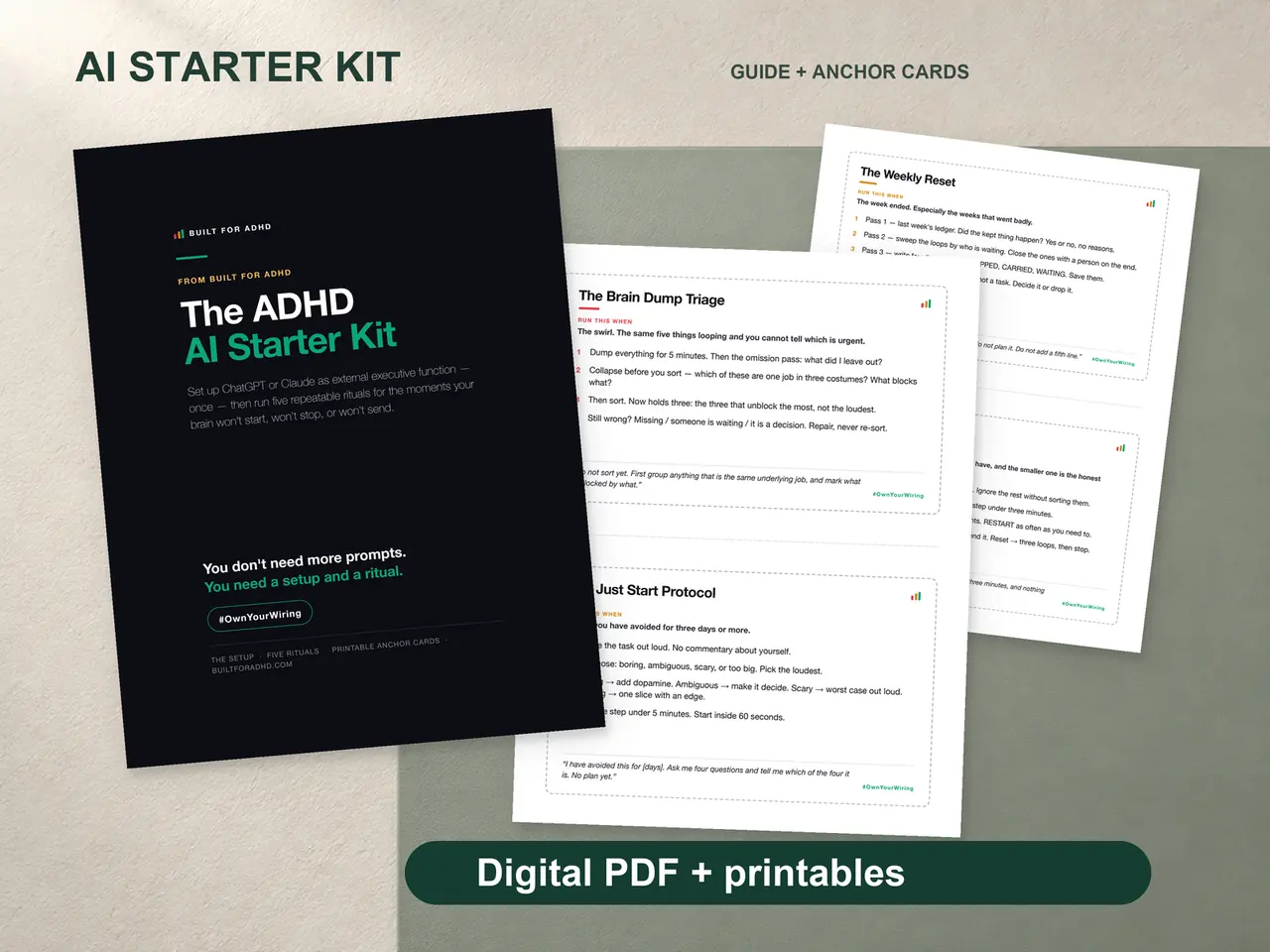
If the honest state of the evidence is “small, early, and promising” and you still want the practical setup rather than waiting on bigger trials to land, that’s what the four-piece ADHD AI Starter Kit is for — a $27 one-time download with the original guide and five rituals, anchor cards, the 50-prompt pack, a ChatGPT/Claude/Gemini Setup Pack, and a plain-words agent guide. It is built from what already works in daily use, not presented as clinically proven, because it hasn’t been, and this page just showed you why that’s true of the entire category right now.
How this page is maintained
This table was reviewed against PubMed, PMC, medRxiv, and arXiv results for ADHD plus large language models, chatbots, or AI-based digital tools on September 20, 2026. It is a dated reference, not an automated literature monitor. If you know of a study that should be here, or think one of the summaries above misrepresents its source, corrections are welcome via /about.
FAQ
Is there real research on AI helping with ADHD? Yes, a small but growing body of it — mostly LLM-accuracy studies and a few small trials, summarized in the table above, and all of it early-stage as of 2026.
Can ChatGPT accurately answer ADHD questions? In one scored study, ChatGPT, Gemini, and DeepSeek R1 reached 87–91% across 22 ADHD-related questions. That result is limited to the study’s prompts and models; reading levels and answer depth still varied, so treat answers as a starting point, not a clinical source.
Does research show AI actually helps ADHD symptoms, not just feels helpful? It’s mixed and thin — the two controlled studies above found either no advantage over a non-AI comparison or improved self-ratings without matching objective test gains, which is different from “no effect” but also different from “proven.”
Is AI body doubling backed by research? Partially — a 2025 VR study found people finished faster and reported greater accuracy and sustained attention with an AI or human double present than working alone. It tested a VR companion with 12 participants, not a consumer text chatbot, so it does not establish a chatbot effect.
Should AI replace a doctor or therapist for ADHD? No — nothing in this research supports that, and several of the studies above say so explicitly in their own conclusions; treat every tool on this page as productivity support, not clinical care.
Related
- The AI for ADHD hub — every setup guide, technique, and honest review in one place
- AI body doubling for ADHD: the complete protocol — the technique the VR study above speaks to
- What is body doubling? — the human version, explained
- Does ChatGPT make ADHD worse? — the honest failure cases
- Is using AI for ADHD cheating? — the scaffold-vs-crutch argument
- AI dependency and ADHD: does it build the skill or rent it? — what to keep exercising
Sources
- Han, X., Xing, R., & Zhou, M. (2026). “Evaluating large language models for ADHD education: A comparative study of ChatGPT 5, DeepSeek V3, and Grok 4.” PLOS ONE. https://journals.plos.org/plosone/article?id=10.1371/journal.pone.0335335
- Bilgiç, B., Turan, S., Avcil, S., & Pekcanlar, A. A. (2026). “How do large language models answer ADHD-related questions? A comparative study of ChatGPT, Gemini, and DeepSeek.” BMC Psychiatry. Europe PMC record: https://europepmc.org/articles/PMC13505058
- Ara, Z., Rahim, I. B., Zhou, P., Yu, L., Esmaeili, B., Yu, L.-F., & Hong, S. R. (2025). “You Are Not Alone: Designing Body Doubling for ADHD in Virtual Reality.” arXiv:2509.12153. https://arxiv.org/abs/2509.12153
- Zhu, Y., Guo, Y., Marchuck, N., Sarker, A., & Wang, Y. (2025). “Leveraging large language models and traditional machine learning ensembles for ADHD detection from narrative transcripts.” arXiv:2505.21324. https://arxiv.org/abs/2505.21324
- Cañadas, E., Maestu, F., & de Ramon, I. (2025). “A Randomized Controlled Trial of an Intelligent Cognitive Stimulation Program for Adults with ADHD: Study Protocol.” Journal of Clinical Medicine, 14(18), 6629. https://pmc.ncbi.nlm.nih.gov/articles/PMC12471158/ (DOI: 10.3390/jcm14186629)
- Hao, Z., Xu, H., Wang, C., Wang, B., & Qiu, Z. (2026). “Multimodal Digital Therapeutics Enhanced by Task Design and AI for Attention-Deficit/Hyperactivity Disorder Core Symptoms and Executive Functions in Children and Adolescents: Systematic Review and Network Meta-Analysis of Randomized Controlled Trials.” Journal of Medical Internet Research. https://www.jmir.org/2026/1/e95043/ (DOI: 10.2196/95043)
- Bergmann, M., Schröfel, J., Zimmermann, L., Fastenau, A., Pafel, S., Sauermann, P., Fecht, J., Philipsen, A., & Lux, S. (2026). “Effects of a novel individualized digital cognitive training on ADHD characteristics, quality of life, and cognitive functioning in adults with ADHD: A randomized controlled trial.” Journal of Psychiatric Research. https://europepmc.org/article/MED/42142506 (DOI: 10.1016/j.jpsychires.2026.05.021)
- Selaskowski, B., Reiland, M., Schulze, M., Aslan, B., Kannen, K., Wiebe, A., Wallbaum, T., Boll, S., Lux, S., Philipsen, A., & Braun, N. (2023). “Chatbot-supported psychoeducation in adult attention-deficit hyperactivity disorder: randomised controlled trial.” BJPsych Open. https://www.cambridge.org/core/journals/bjpsych-open/article/chatbotsupported-psychoeducation-in-adult-attentiondeficit-hyperactivity-disorder-randomised-controlled-trial/F2B9BC00F147B953A74159231476B775
- Dahò, M., & Caci, B. (2025). “Exploring AI-assisted design of executive function rehabilitation programs for individuals with ADHD: a mixed-methods evaluation of prompts and chatgpt outputs.” BMC Psychology. https://europepmc.org/article/MED/41345900
- Chen, J., Meng, Y., & Nie, K. (2026). “‘Not Just Me and My To-Do List’: Understanding Challenges of Task Management for Adults with ADHD and the Need for AI-Augmented Social Scaffolds.” arXiv:2603.17258. https://arxiv.org/abs/2603.17258