In this article
Sometimes, yes. An unconfigured AI chatbot is an infinitely patient, always-available answer machine, and for a brain that already struggles with novelty-seeking and stopping, that combination can worsen specific ADHD symptoms in specific, predictable ways — not because the tool is bad, but because nobody warns you what an ADHD brain does with something this responsive. The AI for ADHD hub covers the setups that make ChatGPT and Claude genuinely help; this is the other half — where it backfired for me, why, and what stopped it.
The rabbit-hole problem
ChatGPT never gets tired, never has somewhere else to be, and never runs out of follow-up questions. That’s a feature for research and a hazard for a brain built to chase novelty. One question’s answer contains three interesting threads, each with three more, and ninety minutes later you’ve learned a lot about something unrelated to why you sat down. A book runs out of pages. A chat window that can go anywhere never signals “stop here” — the stopping has to come from you, at exactly the moment your brain is worst-equipped to supply it.
Novelty-seeking with a chat box
This doesn’t feel like getting distracted — it feels like being productive. Instead of doing the task, you ask the AI to help you think about the task: reconsidering the approach, comparing frameworks you don’t need. Every reply is genuinely well-written, which is exactly what makes it such an effective substitute for starting. Task initiation is supposed to be the thing AI fixes, when the ask is “give me one two-minute step.” It starts feeding the avoidance instead, the moment the ask quietly becomes “help me feel like I’m making progress on deciding.”
Planning as procrastination
The most seductive failure mode, because it produces a real artifact: a beautiful plan. Ask ChatGPT to plan the project and you’ll get a structured, phase-by-phase breakdown that looks exactly like the executive-function support this site points people toward. The trap is that making the plan feels like doing the project and takes the energy you had today — leaving none for the first actual step once the plan is finished. A plan is a map. It has never once walked anywhere on its own.
The honest cases where it made a week worse
The three-hour “quick question.” I opened ChatGPT to ask one thing about a client email. By the time I looked up, I’d redesigned an unrelated part of my pricing with the AI’s enthusiastic help, and the email was still unsent. Every reply was useful in isolation. The chat had no edges, and I supplied none.
The plan that replaced the doing. A launch I’d been avoiding got a gorgeous six-phase plan with contingencies for problems that didn’t exist yet. The actual first phase — one email — didn’t go out for another eleven days. The plan had absorbed the anxiety the task was generating, which felt like relief and functioned like a well-organized form of not starting.
The reassurance loop. On a bad RSD week, I reread a difficult conversation with ChatGPT and asked it to reassure me the other person wasn’t upset, then asked again an hour later with different wording. It answered kindly every time. Kindness on a loop isn’t support — it’s asking a friend the same question nine times because the answer never lands. RSD doesn’t resolve with more reassurance, it gets fed by it.
The guardrails that fixed it
Session contracts. Before opening the chat, state the job and the exit condition — “I am drafting the reply to Marcus, done when the draft exists,” not “figuring out the Marcus situation.” A vague entry produces an expandable session; a named exit gives it somewhere to end.
The setup block. Custom instructions that cap replies at three actions and flag drift do the stopping structurally, instead of relying on willpower at the moment it’s weakest. Add one line: “if I ask something unrelated to today’s task, say so before answering.” That sentence has closed more rabbit holes for me than any amount of self-monitoring.
Closing the tab on purpose. Not minimizing — closing. A minimized chat is a held-open door; a closed one is a decision already made. Read the final answer once, take the one action it named, and close the window before the “oh, but what about” thought finishes forming.
What this doesn’t mean
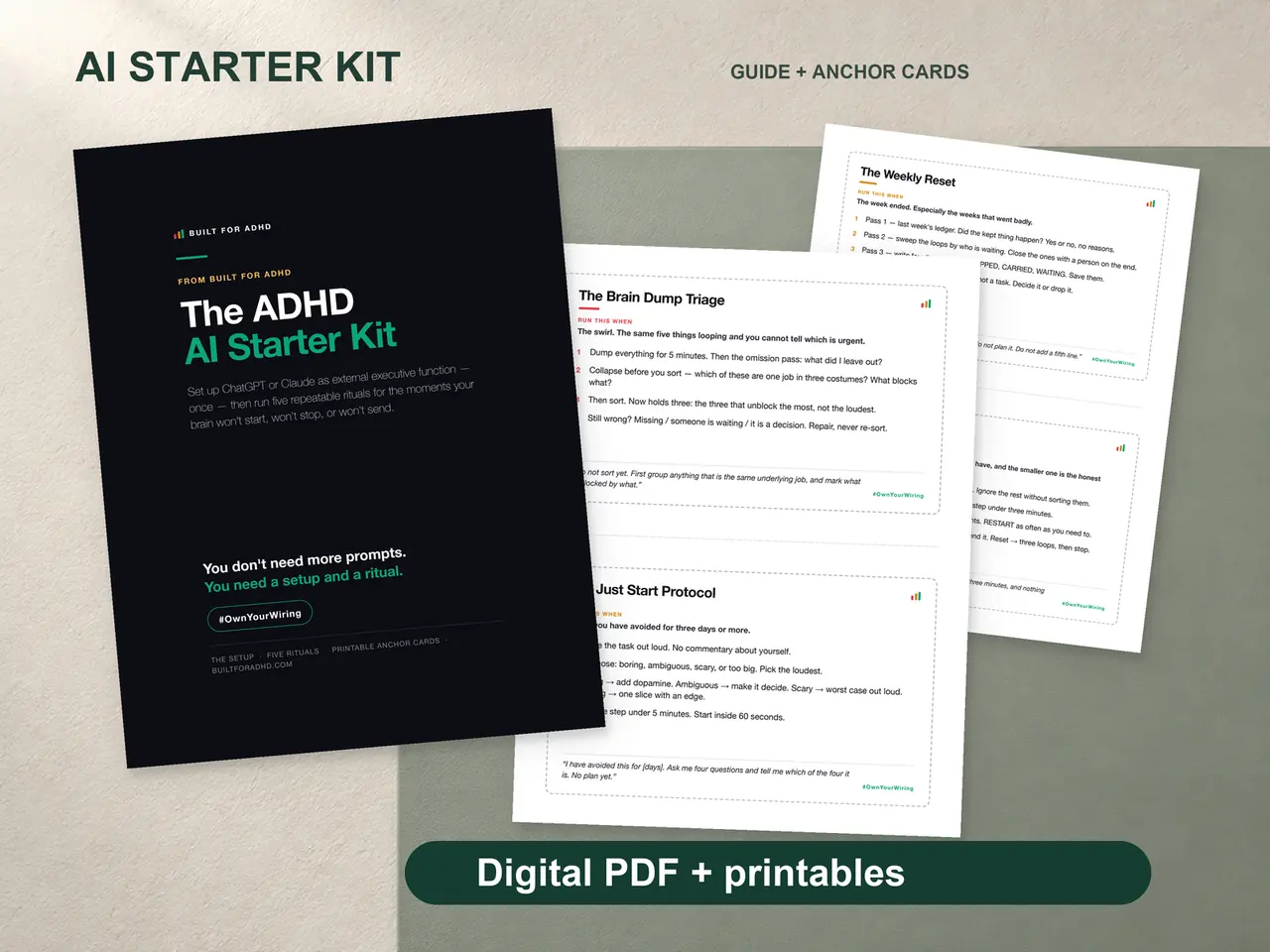
None of this makes ChatGPT bad for ADHD, any more than a sharp knife makes cooking dangerous. The OzCHI diary study describes real, load-bearing help for people who use it daily — that’s also most of my experience, which is why the setup guides exist. The failure mode above shows up specifically when a session is unconfigured and shapeless, exactly the gap a ten-minute setup closes. For the fuller system — both setup blocks, rituals, and printed cards for putting the screen down entirely — that’s the ADHD AI Starter Kit, $27 once.
FAQ
Does ChatGPT make ADHD symptoms worse? Not inherently, but an unconfigured session can amplify two symptoms — novelty-seeking and difficulty stopping — because the tool has no natural edges. Configuration and session limits close that gap for most people within days.
Is AI making my ADHD worse, or is it just a new place for old patterns? Usually the second. Rabbit-holing, planning-as-procrastination, and reassurance-seeking predate ChatGPT — they used to happen in browser tabs and repeated texts to a patient friend. AI is just faster and more available.
How do I stop going down rabbit holes with ChatGPT? State the task and exit condition before typing, use a custom-instructions block that caps replies and flags drift, and close the tab fully once you’ve taken the one named action.
Can making a plan with AI be a form of procrastination? Yes, when the plan absorbs the anxiety the task was generating instead of leading into the first step. A plan you haven’t started acting on in the same sitting is a warning sign, not a finish line.
Should I stop using AI if I notice these patterns? Try the guardrails first, for a week. Most people find the pattern was about missing structure, not the tool; if it persists with real session limits, notice that without shame.
Related reading
- Is using AI for ADHD cheating? — the honest line between scaffold and crutch
- AI dependency and ADHD: does it build the skill or rent it? — what’s worth exercising versus outsourcing
- ChatGPT custom instructions for ADHD — the setup that closes most of this gap
- Can ChatGPT help with ADHD? An honest answer — where it fixes things and where it fails
- The AI for ADHD hub — every setup guide, technique, and honest review in one place
Sources
- “‘A little bit of a life raft’ — Exploring the Use and Experiences of ChatGPT as a Support Tool among Adults with ADHD.” Proceedings of the 37th Australian Conference on Human-Computer Interaction (OzCHI ‘25), 2025. N=13 seven-day diary study. https://doi.org/10.1145/3764687.3764713
- Sophos, S. “Harnessing Artificial Intelligence to Live Better with ADHD.” CHADD, Attention Magazine, December 2024. https://chadd.org/attention-article/harnessing-artificial-intelligence-to-live-better-with-adhd/