In this article
It depends which part of executive function you mean — some of it is safe to rent from an AI indefinitely, and some is worth continuing to build. The two get lumped together because “executive function” sounds like one thing when it’s actually a bundle of separate skills with different rules. This is the honest version of the dependency question, not the reflexive “everything you outsource makes you weaker” take, and not “there’s no downside” either. The AI for ADHD hub has the setup guides; this is about what the setup does to your brain over time.
What executive function actually is
It isn’t one muscle — it’s distinct cognitive processes that fail together in ADHD brains because they share overlapping neural real estate. The ones that matter here: working memory (holding information active while you use it), task initiation (starting something you’re not currently doing), sequencing (ordering steps), and emotional regulation (not getting derailed by frustration or rejection sensitivity mid-task). CHADD’s coverage of AI for ADHD names this precisely: AI works as a scaffold that “can significantly reduce the cognitive load on our working memory” — a specific claim about one function, not executive function in general. Treating the four as one thing is how this conversation goes generic and unhelpful.
Which parts an AI can hold indefinitely, at no real cost
Working memory. Externalizing a list has never been a skill worth training — you don’t get better at holding seventeen tasks in your head through practice, you just get more anxious. A written list, AI-maintained or on paper, has always been the fix.
Sequencing for a one-off task. Asking AI to order the eleven hidden steps inside “renew my passport” isn’t a skill worth internalizing for passport renewal specifically, since you’ll do it again in ten years under different rules. The value was getting unstuck today.
Formatting output. Turning a brain dump into a clean list is closer to using a spell-checker than to writing itself. Nobody worries spell-check erodes spelling ability, because the thinking behind what you wanted to say was still yours.
Which parts you actually want to keep exercising
Task initiation, on tasks that repeat. Getting the first two-minute step from AI every time is a good use of the tool. But if every task, forever, needs that external nudge with zero internal capacity building, that’s worth noticing — initiation does respond to structured practice, and fully outsourcing it forever forecloses on whatever gains were available.
The actual decision. The scaffold-versus-crutch line lives here. Listing options is scaffolding. Having AI pick the option, every time, on decisions that matter, means the part of you that tolerates choosing under uncertainty never gets asked to do its job — and that tolerance is built through repetition, the same as any distress tolerance.
Emotional regulation in the moment. Using AI to draft a reality-checked reply mid-spiral is legitimate. Using it as your only regulation mechanism, every time, with nothing in reserve, means a single point of failure — and you want a second option that lives in you.
The rent-vs-build test
Before leaning on AI for a function, ask: if I did this manually, badly, right now, would repetition make me measurably better at it — or just slower with no gain?
If “no gain” — memorizing a list, one-off sequencing, formatting — rent it permanently, no guilt. That’s not a downgrade; nobody builds long-division fluency anymore because calculators made it a rented function decades ago.
If “yes, repetition builds something” — starting tasks, tolerating a hard decision, riding out rejection sensitivity without an outside voice — exercise it on purpose sometimes, even when the AI-assisted version is easier. Not every time, just often enough the muscle doesn’t fully atrophy. CHADD’s Yulia Rafailova names the risk directly: over-relying on AI “to do our thinking for us may weaken the mental skills we develop through our own effort and struggle.” The rent-vs-build test applies that warning to the specific function in front of you, instead of treating it as a blanket reason to avoid the tool.
Dependency versus accommodation
Accommodation means the tool closes a gap that would otherwise cost you disproportionately, and the cost of not having it is real — the way a wheelchair ramp isn’t “dependency” on architecture, it’s access. If your working memory genuinely drops information under load, offloading it to an AI-maintained list is accommodation, regardless of how long you keep doing it.
Dependency means the absence of the tool doesn’t just cost more effort, it erases a capability that used to exist — you could hold a five-item list under pressure two years ago, and now you can’t, even briefly, even when the AI isn’t available. That’s a skill atrophied from disuse, worth noticing on the “keep exercising” list above specifically.
The practical test: try the task without the tool occasionally, no stakes, purely a check-in. Slower but possible means accommodated. Doesn’t happen at all is useful information, not a verdict — it usually means running that ritual manually for a stretch, the way you’d occasionally do a sum by hand.
The bottom line
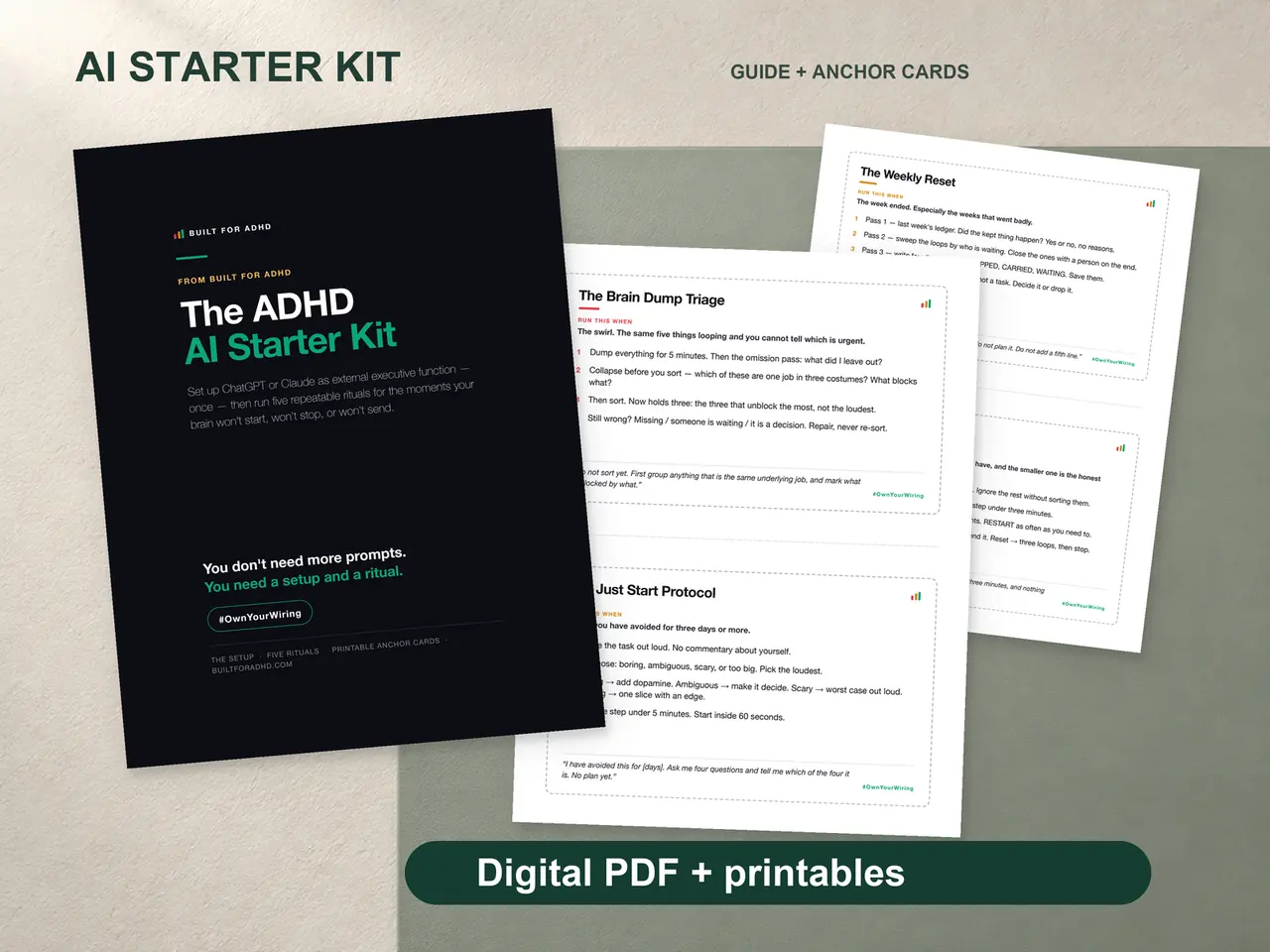
Rent the parts that were never going to build a skill anyway — working memory, one-off sequencing, formatting. Keep exercising the parts that respond to practice — initiation, decision tolerance, riding a wave of feeling without an outside voice. The ADHD AI Starter Kit is built around that split: rituals for the jobs worth renting, and a setup designed to hand you the first step rather than the whole task, so initiation stays a muscle you use. $27 once; free tiers cover everything else.
FAQ
Can you become dependent on AI with ADHD? Yes, on specific functions — most commonly task initiation and decision tolerance, not working memory, which was never a skill worth training in the first place.
Does using AI for executive function make ADHD worse over time? Not inherently, and there’s no evidence it changes the underlying condition. What can happen is skill atrophy on functions that respond to repetition, if every instance is fully outsourced.
What’s the difference between accommodation and dependency? Accommodation costs more effort without the tool but the task is still possible; dependency means the task becomes impossible without it, even briefly, on something you used to be able to do.
Which ADHD-related tasks are safe to fully outsource? Working memory, one-off sequencing, and formatting — none were skills that improved with repetition to begin with.
Which tasks should I keep practicing myself? Task initiation on recurring work, tolerating a hard decision, and riding out an emotional spike without an immediate outside voice — all respond to practice.
Is this a mental-health question? No — this is productivity and skill-building guidance, not medical advice. Nothing here diagnoses or treats ADHD, or replaces medication, therapy, or coaching already working for you.
Related reading
- Is using AI for ADHD cheating? — the scaffold-versus-crutch line this piece builds on
- Does ChatGPT make ADHD worse? — the failure modes and the guardrails that fix them
- Is it safe to tell ChatGPT about my ADHD? — what to share and what to keep off a chat log
- Can ChatGPT help with ADHD? An honest answer — what it fixes day to day
- The AI for ADHD hub — every setup guide, technique, and honest review in one place
Sources
- Sophos, S. “Harnessing Artificial Intelligence to Live Better with ADHD.” CHADD, Attention Magazine, December 2024 (quotes Yulia Rafailova on scaffolding and over-reliance). https://chadd.org/attention-article/harnessing-artificial-intelligence-to-live-better-with-adhd/
- Dolin, A. “Navigating AI Responsibly.” CHADD, Attention Magazine, August 2023. https://chadd.org/adhd-news/adhd-news-caregivers/attention-navigating-ai-responsibly/