In this article
Mostly yes — telling ChatGPT or Claude you have ADHD, to get better task breakdown and a calmer tone, is safe the way most people mean the question, and it’s what the setup guides on this site ask you to do. But “safe” has a narrower meaning too: a chat log is not a privileged, confidential record the way a conversation with a therapist or doctor is, and you should decide what to type with that in view. This is a productivity post, not medical or legal advice.
What a chat log actually is
A conversation with ChatGPT or Claude is a record stored by a company, retrievable by that company, and potentially producible in a lawsuit the way any stored business record can be. OpenAI’s Sam Altman said this plainly on the podcast This Past Weekend w/ Theo Von in July 2025: people talk to ChatGPT about “the most personal sh*t in their lives” the way they would to a therapist, but “[i]f you talk to a therapist or a lawyer or a doctor about those problems, there’s legal privilege for it… [a]nd we haven’t figured that out yet for when you talk to ChatGPT.” He added OpenAI would currently be “legally required to produce those conversations” if compelled by a court — the CEO of the company that makes ChatGPT, saying the quiet part about his own product. None of that means don’t use it. It means treat a chat log like an email or text message, not a session with a licensed provider — because legally, that’s what it is.
What the setup block needs to know versus what it doesn’t
The instructions block that makes ChatGPT or Claude useful for ADHD needs almost none of your health history. It needs behavioral preferences, not a diagnosis narrative.
What it needs: that task initiation is hard and you want one small action, not a plan; that your working memory drops things, so answers should be short and written down; a cap on action items at once; a request to name it plainly if you’re rabbitholing; pinned days over vague words like “later.” Each is a preference about delivery — the model doesn’t need to know why.
What it doesn’t need: diagnosis date, medication name or dosage, a clinician’s name, evaluation details, or a family member’s diagnosis. None of that changes how the model breaks down a task. It’s the detail that feels natural to include because you’re explaining yourself, and the kind that adds real risk for zero functional benefit.
Data controls, as they actually exist
ChatGPT. Under Settings → Data Controls, an “Improve the model for everyone” toggle controls whether conversations train future models — turning it off is forward-looking, stopping new conversations from training without retroactively removing anything already incorporated. Temporary Chat keeps a conversation out of your history and out of training, though OpenAI may still retain a copy briefly for safety review either way — the retention isn’t zero, even when the training use is.
Claude. Anthropic’s privacy center confirms conversations train models only if you’ve opted in via “Help improve Claude,” with one exception: Incognito chats are excluded from training even when that setting is on. Per Anthropic’s help center, Incognito chats aren’t saved to your history or Claude’s memory — but they’re still retained (30 days by default, longer on Enterprise plans) for safety and compliance.
The pattern across both: a private-mode toggle stops the tool from learning your conversation, but neither company claims the conversation vanishes immediately. Not trained on versus not retained at all is the distinction worth understanding before you decide what to type.
Share / don’t share
| Type of detail | Share it | Why |
|---|---|---|
| ”Task initiation is hard, give me one small step” | Yes | Behavioral preference; makes the tool work |
| ”I lose track of lists, keep answers short and numbered” | Yes | Functional, not medical |
| ”Call it out if I’m rabbitholing” | Yes | Functional instruction |
| Diagnosis date or evaluating clinician’s name | No | Identifying detail, no functional benefit |
| Medication name or dosage | No | Health record detail the model doesn’t need |
| A specific crisis-level disclosure | No | Not what a chat log is built or protected to hold — talk to a person |
| A family member’s diagnosis or health details | No | Not yours to disclose, and unneeded for setup |
| Account numbers, SSN, employer HR details | No | Never share these with any AI chat |
Employer and shared-device notes
On a work-issued account, assume employer IT or admins can see conversation logs under most enterprise retention policies — this varies by plan, so treat a work account like a work email, not a private notebook. Run anything ADHD-related through a personal account on your own device instead.
On a shared or family device, chat history persists in the browser or app unless you’re in a private mode, and a saved login means anyone who opens it can scroll back. If you’re setting up custom instructions on a shared device, use a private browsing session or your own logged-in profile.
The bottom line
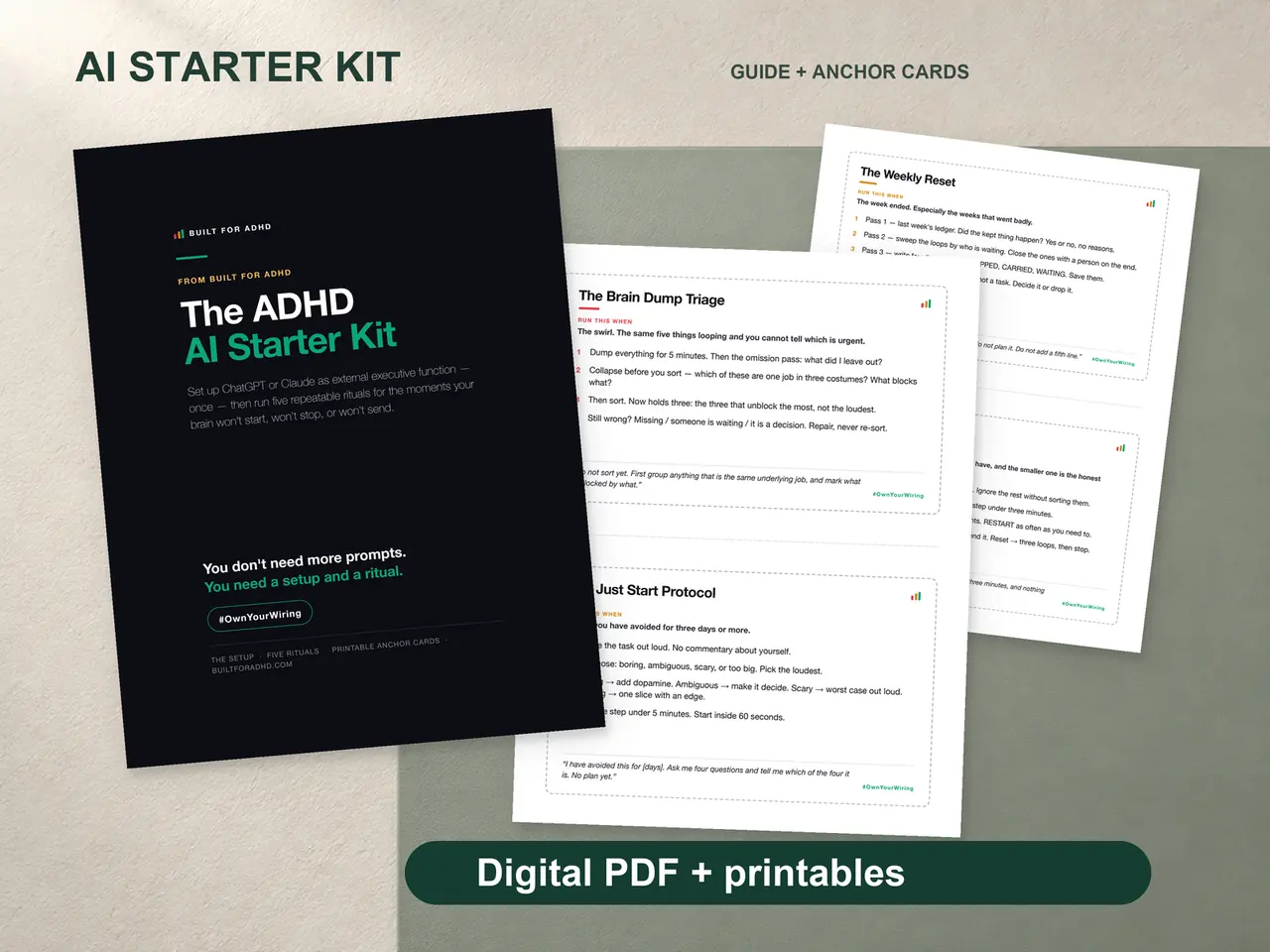
Tell the assistant how your brain works — the behavioral preferences that make the setup function. Leave out the parts of your health record that don’t change how it answers: diagnosis specifics, medication, anyone else’s health information. Use the training opt-out and private-chat modes on both platforms if you want a lighter footprint, knowing “not trained on” and “gone forever” are different promises. None of this is medical or legal advice. The ADHD AI Starter Kit ships both setup blocks pre-written to need exactly the functional detail above and nothing more; the free version is the ADHD AI prompt pack.
FAQ
Is it safe to tell ChatGPT I have ADHD? For better task breakdown and pacing, yes — that’s a behavioral preference, not sensitive health data, and it’s exactly what the standard setup asks for. Be more careful with anything beyond that: diagnosis specifics, medication, or crisis-level disclosures, which a chat log isn’t built or legally protected to hold.
Does ChatGPT have doctor-patient or therapist confidentiality? No. OpenAI’s own CEO has said publicly that conversations don’t carry legal privilege the way a conversation with a therapist, doctor, or lawyer does, and the company could be legally compelled to produce chat logs in litigation.
Can I stop ChatGPT or Claude from training on my ADHD-related conversations? Yes, on both. ChatGPT has an “Improve the model for everyone” toggle plus Temporary Chat; Claude has a “Help improve Claude” setting plus Incognito chats, excluded from training even when that setting is on. Neither guarantees immediate deletion — both retain data briefly for safety.
Should I use a work AI account for ADHD-related prompts? No — use a personal account on your own device. Work accounts commonly give employer admins visibility into logs.
Is this mental-health advice? No. This is productivity and privacy guidance about what to type into a chat interface — it doesn’t diagnose, treat, or advise on ADHD as a medical condition. A clinical conversation belongs with a qualified healthcare provider, not a chat log.
Related reading
- Is using AI for ADHD cheating? — the honest scaffold-versus-crutch line
- Does ChatGPT make ADHD worse? — the rabbit-hole problem and the guardrails
- AI dependency and ADHD: does it build the skill or rent it? — what’s safe to fully outsource
- ChatGPT custom instructions for ADHD — the setup itself
- The AI for ADHD hub — every setup guide, technique, and honest review in one place
Sources
- Perez, S. “Sam Altman Warns There’s No Legal Confidentiality When Using ChatGPT as a Therapist.” TechCrunch, July 25, 2025 (comments made on the podcast This Past Weekend w/ Theo Von). https://techcrunch.com/2025/07/25/sam-altman-warns-theres-no-legal-confidentiality-when-using-chatgpt-as-a-therapist
- “Is My Data Used for Model Training?” Anthropic Privacy Center. https://privacy.claude.com/en/articles/10023580-is-my-data-used-for-model-training
- “Use Incognito Chats.” Claude Help Center. https://support.claude.com/en/articles/12260368-use-incognito-chats
- “ChatGPT: Temporary Chat Can Now Use Your Saved Memories.” Notebookcheck. https://www.notebookcheck.net/ChatGPT-Temporary-chat-can-now-use-your-saved-memories.1382374.0.html
- “Does ChatGPT Train on Your Conversations? What Actually Happens to Your Data.” Evenfall. https://www.evenfall.ai/guides/does-chatgpt-train-on-your-conversations