In this article
No, using AI for ADHD is not cheating — for the same reason glasses aren’t cheating for someone who can’t read the board. You’re not skipping the work; you’re removing an obstacle that was never testing the thing you actually needed to prove. Every guide on the AI for ADHD hub starts from that premise. But the feeling that it’s cheating is real and common, so here’s where it comes from, and the one place it’s actually onto something true.
The glasses argument, done honestly
Nobody accuses someone of cheating at reading because they wear glasses: glasses correct a gap between what the eye can do and what the page demands, and the reading itself is still the reader’s. AI used the way our setup guides describe does the same job for a different gap. Task initiation, working memory, and decomposition cost an ADHD brain more than they should — not from laziness, but because executive dysfunction is a real, measurable difference in how the brain manages itself. A tool that closes that gap so the actual thinking and doing can happen is a correction, not a substitute.
The part that makes the analogy hold up: glasses don’t do the reading for you, and they don’t skip you to the ending — they remove the blur. AI that passes this test does the equivalent: breaking a task into a size you can start, holding the list, sitting with you as a body double while you do the actual task. The task still gets done by you. Run that test on the specific use, not the category.
Where it genuinely feels like cheating
When it’s easy. If a task used to cost an hour of dread and now costs five minutes, the speed itself can feel suspicious — like the difficulty was the proof you were trying, and removing it removed the proof. It didn’t. The difficulty was never the point of the email. Sending it was.
When nobody else needs it. Watching a coworker draft the same message unassisted can feel like you needed a workaround they didn’t. It’s the same gap that makes someone reach for a calculator for math you do in your head — different brain, different expensive operation, no moral failing on either side.
When you were taught productivity has to hurt. A lot of us grew up on “if it’s not hard, it doesn’t count.” The ADHD tax is the receipt for a lifetime of that belief applied to a brain it was never built for — which is why ease itself gets misread as evidence of wrongdoing, when it’s really just evidence the tool fits. None of that is a defense you need to mount out loud. The shame is inherited, not evidence.
Where it’s actually a problem
There is a real line, and crossing it isn’t really about AI at all: the line is the deciding. Using AI to list tradeoffs or draft options is scaffolding — you still choose. Handing over the actual decision because choosing itself is what you’re avoiding doesn’t fix the avoidance, it relocates it. Same with the parts of a task that are the point — if the assignment is your own analysis, or the email needs to sound like you because the relationship depends on it, outsourcing that specific piece isn’t a productivity hack, it’s not doing the thing that was asked. That’s true for anyone, ADHD or not.
The honest test isn’t “did I use AI,” it’s “did I make the call, or did I let the tool make it so I wouldn’t have to feel making it.” The second one feels identical to relief in the moment and shows up as a cost later.
The line between scaffold and crutch
Both are something you lean on; the difference is what happens when you take it away. A scaffold, removed, leaves the structure standing — you did the task, and doing it again without help would be slower, not impossible. A crutch, removed, means the thing collapses, because the crutch was load-bearing the whole time. The practical test: after AI breaks a task down, could you now do that specific task without it, even badly? If yes, it was scaffolding. If the honest answer is “no idea,” that’s worth noticing, not panicking about — which parts are worth exercising is its own question, with its own honest answer.
The bottom line
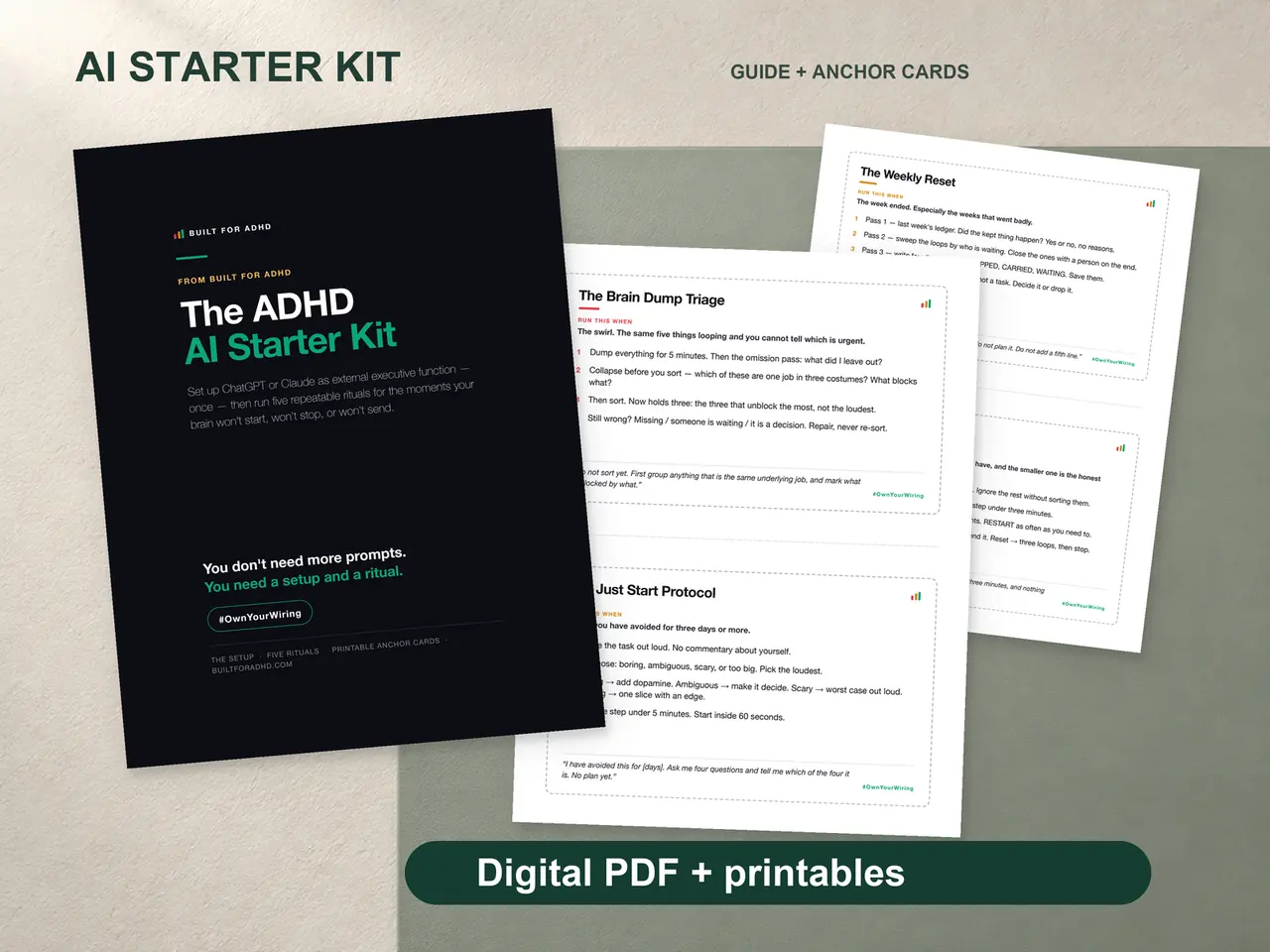
The glasses argument is right: needing a correction isn’t a character flaw. It’s also not the whole answer — the whole answer includes the one place the worry is legitimate, handing over the deciding, not the doing. Keep that line in view and the rest of the guilt can go. The free setup takes ten minutes; the ADHD AI Starter Kit is the $27 version that installs both assistants’ setup blocks, five rituals, and printed cards in one evening.
FAQ
Is it cheating to use ChatGPT for schoolwork or work tasks if you have ADHD? It depends what the task is testing. If it’s testing your own output — your analysis, your voice in a relationship that depends on it — doing that part with AI is skipping the assignment. If it’s testing whether the work got done, using AI to clear the executive-function tax on getting there is scaffolding.
Does needing AI to start tasks mean something is wrong with my brain? No — task initiation costs your brain more than it costs some other brains, a consistent finding in ADHD research, not a personal failing. Needing a tool for an expensive operation is normal.
Will using AI for everything make me worse at doing things myself? Not if it’s scaffolding — task breakdown, holding your list, a first draft — because those still require you to do the task. Watch for offloading the deciding, not the doing; that’s the actual dependency question.
What’s the difference between using AI as a tool and being dependent on it? A tool you could function without, slower and worse, is scaffolding. Something whose absence means the task doesn’t happen at all is a crutch. Try the task without AI occasionally and see which one is true.
Is this productivity framing, or is it treatment? Productivity only. Nothing here diagnoses or treats ADHD, and none of it replaces medication, therapy, or coaching where those are working for you.
Related reading
- Does ChatGPT make ADHD worse? — the honest failure cases and the guardrails that fix them
- AI dependency and ADHD: does it build the skill or rent it? — the rent-vs-build test
- Is it safe to tell ChatGPT about my ADHD? — what a chat log actually is
- Can ChatGPT help with ADHD? An honest answer — what it fixes and where it fails
- The AI for ADHD hub — every setup guide, technique, and honest review in one place
Sources
- Sophos, S. “Harnessing Artificial Intelligence to Live Better with ADHD.” CHADD, Attention Magazine, December 2024. https://chadd.org/attention-article/harnessing-artificial-intelligence-to-live-better-with-adhd/
- “‘A little bit of a life raft’ — Exploring the Use and Experiences of ChatGPT as a Support Tool among Adults with ADHD.” Proceedings of the 37th Australian Conference on Human-Computer Interaction (OzCHI ‘25), 2025. N=13 seven-day diary study. https://doi.org/10.1145/3764687.3764713
- ADDitude Editors. “‘A Cognitive Collaborator’: How Adults with ADHD Are Using ChatGPT.” ADDitude Magazine, updated May 9, 2025. https://www.additudemag.com/how-to-use-chatgpt-executive-function-adhd/