In this article
Direct answer: AI works well here as a neutral third party for a specific, narrow job: turning an invisible, resentment-loaded household workload into a visible list both partners can actually look at and divide — not as a mediator for the relationship itself, and not as a way to prove who’s “right.” Used for the list, it can defuse a fight that’s usually less about the dishes and more about the fact that one partner is holding a mental inventory the other doesn’t know exists.
If you’re the ADHD partner in this dynamic, or the partner of someone with ADHD, this is written for both directions, because the actual pattern — one person’s forgetting reads as not caring, one person’s over-functioning reads as controlling — cuts across who has the diagnosis.
What’s actually happening in the fight
The recurring fight in a lot of ADHD households isn’t really “you didn’t do the dishes.” It’s a mismatch between two invisible things: the ADHD partner’s genuinely inconsistent follow-through on tasks that don’t have an external trigger, and the non-ADHD partner’s mental load of remembering, tracking, and re-asking for things that should have happened without a reminder. Both experiences are real. Neither person is lying about their side of it. And neither side is fixed by the other partner trying harder to feel differently about it — it’s fixed, if it’s fixed, by changing the system underneath the fight, not the feelings on top of it.
This is where “just communicate better” advice usually fails: the problem isn’t a communication gap, it’s that one partner’s workload was never made visible in the first place, so there’s nothing concrete to communicate about — just a feeling of unfairness on one side and a feeling of being nagged on the other. The same external-structure principle behind AI as executive function generally applies at the household level too — the fix isn’t more willpower or better feelings, it’s a visible system neither partner has to hold entirely in their own head.
Where AI genuinely helps
Making the invisible list visible, together. Sit down together (this matters — not as a solo prep task by either partner) and describe every recurring household task you can think of to an AI assistant, however incomplete the list feels. Ask it to organize what you named into categories — daily, weekly, monthly, “remembered but never scheduled” — and to ask follow-up questions about tasks that sound like they exist but nobody named yet, like restocking or gift-buying or scheduling appointments. The AI isn’t deciding who does what; it’s doing the tedious work of turning a vague, contested sense of “there’s a lot going on” into an actual list you can both see at the same time.
Splitting without keeping score. Once the list exists, ask the AI to help propose a split based on each person’s actual capacity and preference, not an even 50/50 split by task count — some tasks take two minutes, some take an hour, and a fair split accounts for that instead of just counting items. “We have this list of 40 household tasks. I have more flexible time on weekday mornings, my partner works from home Tuesday/Thursday. Help us draft a split that accounts for actual time and energy, not just task count.” This removes the emotionally loaded part of dividing labor — proposing the first draft — from either partner, so neither of you has to be the one who suggests a split that looks self-serving.
A neutral script for renegotiating when it breaks down. Splits drift. When one falls apart — usually because the ADHD partner’s follow-through was inconsistent on tasks without an external trigger, or because life circumstances changed — ask AI to help draft a check-in script that names the drift without assigning blame: “This task keeps not happening. What about the current setup makes it hard, and what would make it easier?” is a very different conversation than “why do you keep forgetting this.”
What AI can’t do here
It can’t do the actual talking for you, and it shouldn’t be used by one partner alone to build a case against the other — that turns a neutral tool into a weapon in the same fight it was supposed to help resolve. If the underlying conflict is about respect, trust, or something deeper than task division, a household task list won’t fix it, and that’s a conversation for the two of you, possibly with a couples counselor, not a chat window. This tool is for the logistics layer of the problem, not the emotional layer underneath it.
Why “just try harder” was never going to work
Most household-labor advice aimed at ADHD couples eventually lands on some version of “the ADHD partner needs better systems” — reminders, apps, alarms. That advice isn’t wrong, but it puts the entire fix on one partner’s shoulders, as though the workload imbalance is purely a personal-productivity failure rather than a shared structural gap. An external reminder system can genuinely help the follow-through half of the problem. It does nothing for the half where the non-ADHD partner has been the only one holding the full mental inventory of what needs doing at all — noticing the task exists in the first place, not just remembering to do it once assigned.
That’s the actual reason a shared AI-built list matters more than another app aimed at just the ADHD partner: it puts the noticing work on the table too, not only the doing work. A task the non-ADHD partner has been silently tracking for two years — refilling the kids’ school supplies before they run out, say — only becomes fixable once it’s named out loud and assigned, rather than living permanently in one person’s head as an uncredited, invisible job.
A concrete starting point
Set aside 20 minutes, together, phones and defensiveness both put away as much as possible, and open a shared chat session (or one person drives while both talk it through out loud). Brain-dump every task either of you can think of, then ask the assistant to sort, group, and propose a first-draft split for you to react to and adjust — not accept as-is. The AI’s version doesn’t have to be right. It just has to exist, so you’re negotiating from a shared document instead of two different mental lists that were never compared.
FAQ
Should only the ADHD partner use AI to fix this, since they’re the one forgetting? No — this works best as a joint activity. If only one partner builds the list or proposes the split, it tends to feel imposed rather than agreed on, which recreates the same power imbalance the exercise is meant to fix.
What if we build a list and split, and it falls apart again in a month? That’s normal and not a sign the exercise failed. Splits need periodic renegotiation, especially in ADHD households where circumstances and capacity shift. Treat the check-in script above as a recurring tool, not a one-time fix.
Is this a substitute for couples counseling if the fight is about more than chores? No. If the household-labor fight is a symptom of a deeper trust or respect issue, that needs a person qualified to work with couples, not an AI list-maker. This tool addresses the logistics layer only.
Which AI tool should we use for this? Any general assistant — ChatGPT or Claude — works fine for this specific task. No specialized app is needed; the value is in the conversation and the list, not the platform.
Related
- ADHD Chore Split System for Partners — a more detailed system once the initial list exists
- Co-Parenting with ADHD: A Communication System — for when kids are part of the equation too
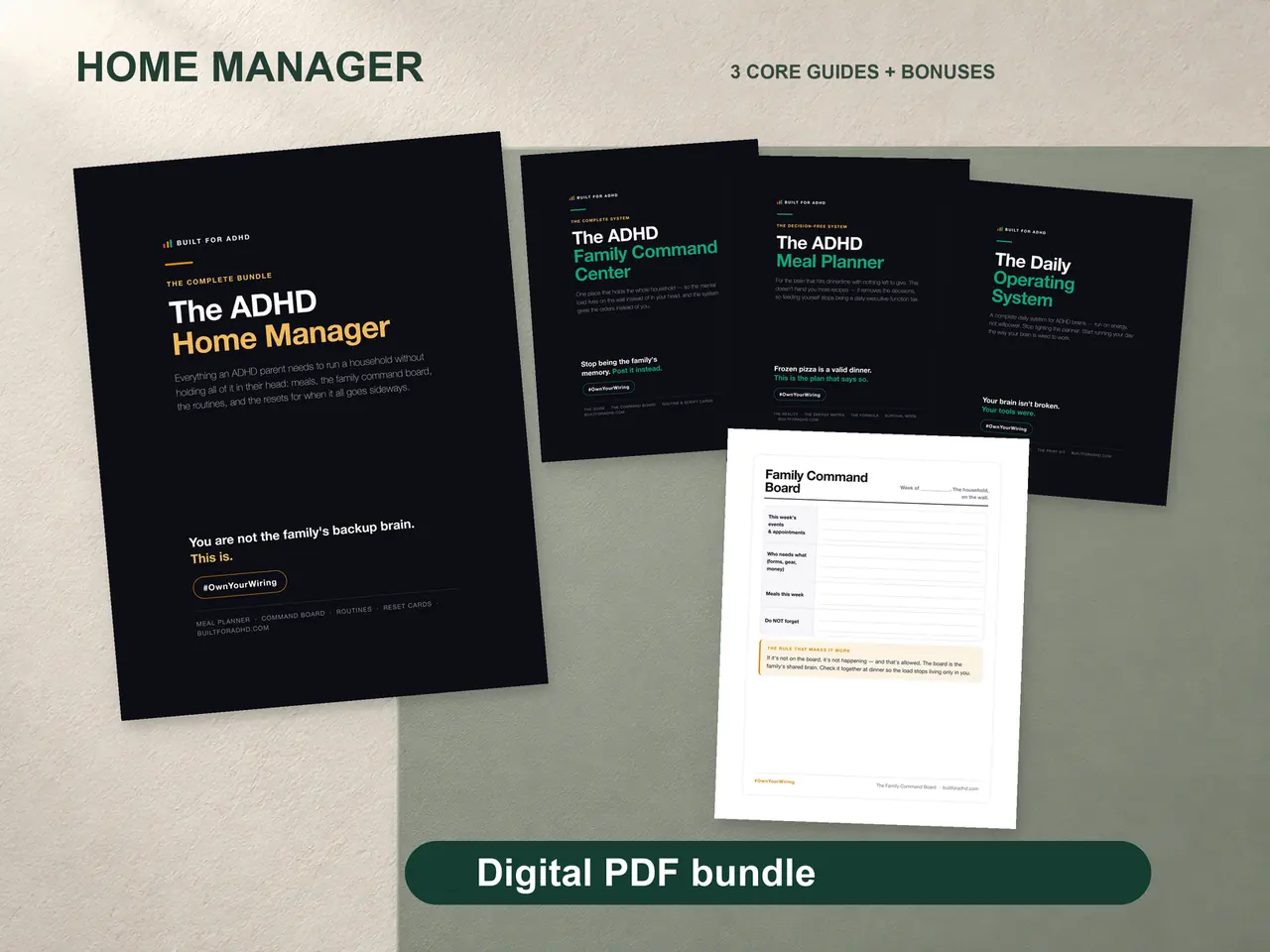
- ADHD Home Manager — $47, the full household system this exercise feeds into
- The AI for ADHD hub — every setup guide and honest review in one place