In this article
You don’t need a person in the room to get most of what body doubling does for your brain. A study-with-me video, a phone call with the camera on, a declared task running against a timer, narrating your own steps out loud, or an AI session that checks in on you — each one borrows the same mechanism a human body double uses: a witness, a container, and a reason to stay inside it. None of them require someone else to be awake, free, or willing to sit in your kitchen. (Body doubling is one of the core moves in the complete guide to ADHD tools for adults for exactly this reason: it works with the brain you have.)
That matters because the moments you need a body double most are rarely the moments one is available. It’s 11 PM and the report is due at nine. It’s a Tuesday afternoon and everyone you’d ask is at work. It’s a task you don’t actually want to invite a person into — the doom pile, the overdue reply, the thing you’ve been avoiding for reasons you’d rather not explain out loud. For all of those, here’s what still works when nobody’s around, and what each option keeps and loses compared to having an actual person there.
Study-with-me videos: presence without the ask
A “study with me” video is someone else’s recorded focus session, and your brain treats it like a very quiet, very reliable study partner. Put one on, match their posture, and start. What it keeps: the mirror-neuron effect of watching someone focused, the ambient sense that you’re not doing this in a vacuum, and zero social cost — you never have to ask anyone for anything. What it loses: there’s no real witness. The person on screen has no idea you exist, so there’s no accountability loop and no one to notice if you quietly wander off. It works best for tasks you’re already halfway willing to do — a nudge, not a rescue.
A phone call with the camera on
Call a friend who’s also working on something, prop the phone up where you can both see each other, and go quiet. This is closer to a real body double than a video, because there’s an actual person on the other end who could, in theory, notice if you vanished. What it keeps: real mutual presence, a small social stake, and the option to say “hey, I’m stuck” if you need to. What it loses: you’re managing someone else’s time and attention, which means it needs scheduling — the exact thing that isn’t available at 11 PM.
A timer plus a declared task
This one has no other person in it at all, and it still works better than most people expect. Say your task out loud — even to an empty room — set a timer for 25 or 30 minutes, and start. The declaration does more of the work than it seems like it should: naming the task and the container out loud is part of what a human body double gives you, and you can do that part alone. What it keeps: the container, a defined start and end. What it loses: the witness — there’s no one to notice if you drift, so this option depends entirely on you being honest with the timer.
Narrating out loud
Talk through what you’re doing as you do it — “okay, opening the document, first paragraph is the summary” — the way you might narrate a recipe to someone in another room. It sounds strange until you try it. What it keeps: it occupies the same mental channel that would otherwise generate the “I could just check my phone” thought, so there’s less room for the wander-off impulse, and it makes the task feel witnessed even by no one. What it loses: it’s tiring to sustain past 20 minutes or so, and it’s not exactly private if you’re anywhere near other people.
An AI session that checks in on you
This is the closest stand-in to the real thing, because it can actually do the two jobs a human body double does — hold a declared session and check in — without needing to be free, awake, or told twice how your brain works. Open a chat and say something like: “I feel frozen on this task. Act as my virtual body double for the next 30 minutes — keep me company while I do it and ask gentle check-in questions every ten minutes. Don’t give advice unless I ask.” Then start the tiny, no-pressure first step before you finish reading its reply.
What it keeps: a real check-in loop, available at any hour, with no social battery spent and no one to disappoint if you report drifting. It’s the version that lets you ask the same question at 3am without burdening my people — something a human double genuinely can’t offer once your people are asleep. What it loses: it can’t see you, so the check-ins only work if you answer them honestly, and if what made body doubling work for you was specifically a person’s presence, this will feel thinner. We wrote the full setup — the exact contract, the check-in cadence, the voice-mode version for tasks away from a keyboard — in the AI body doubling protocol.
When to just wait for a human
None of these are a permanent substitute, and some tasks genuinely go better with a person. If a task is emotionally loaded — a hard conversation, a decision you’re avoiding because you’re scared of getting it wrong — a thin version of presence isn’t the missing bridge between thinking and doing; a real person’s attention is. If you’ve tried two or three of these for the same task and you’re still stuck, that’s useful information, not a failure: stop substituting and go find an actual human, even if it means waiting until tomorrow.
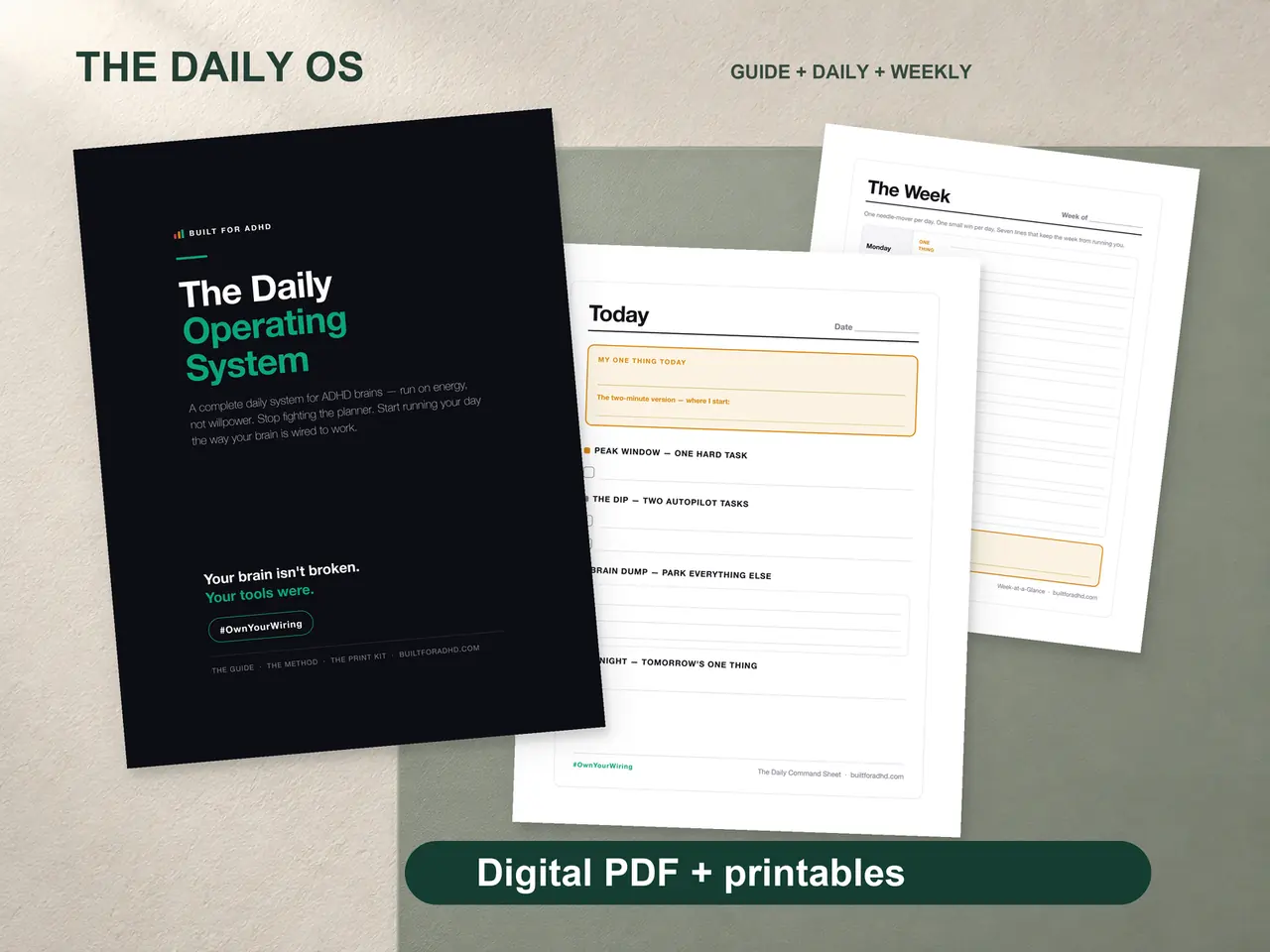
The pattern behind all five of these — and the one worth building into your day regardless of who’s around — is that starting goes better when the task is named and small before you touch it. That’s the whole premise behind the ADHD Daily OS: every task gets sorted by energy and paired with a tiny first step before you ever sit down, so you’re not relying on whoever happens to be in the room (or not) to get you moving. $17, printable, one-time.
FAQ
Does body doubling still work if the other “person” isn’t real? Yes, to a meaningful degree — a 2025 VR study found that both a human companion and an AI companion improved task completion over working alone, which suggests the effect isn’t purely about a real human witness. As of 2026 the direct evidence on body doubling for ADHD is early-stage and small-sample, so treat this as promising, not settled.
What’s the single best option if I only try one? The declared task plus a timer is the best single option, because it costs nothing, needs no app, and teaches you the part of the mechanism you control directly — naming the task out loud and giving it an edge to push against.
Can I combine these methods? Yes, and it often helps — narrate out loud during a study-with-me video, or declare your task to an AI session and then put a timer on top of it. They stack because they’re hitting the same mechanism from different angles.
Why does saying the task out loud matter if no one’s listening? Because a meaningful part of what a body double provides is the act of declaring the session, not just being observed. Speaking the task turns a vague intention into a specific commitment your brain treats differently.
Is this a replacement for a human body double? No — think of it as what you reach for when a human isn’t available, not what you reach for instead of one. Human presence still carries a social-stakes component these stand-ins can’t fully replicate.
Sources
- Zinat Ara et al., “You Are Not Alone: Designing Body Doubling for ADHD in Virtual Reality” (2025), arXiv:2509.12153 — https://arxiv.org/abs/2509.12153
- Tessa Eagle et al., “‘It Was Something I Naturally Found Worked and Heard About Later’: An Investigation of Body Doubling with Neurodivergent Participants,” ACM Transactions on Accessible Computing (2024) — https://doi.org/10.1145/3689648
- Cleveland Clinic, “What Is ‘Body Doubling’ and Can It Help With ADHD?” — https://health.clevelandclinic.org/body-doubling-for-adhd
- Linda Anderson, “The ADHD Body Double: A Unique Tool for Getting Things Done,” ADDA — https://add.org/the-body-double/
Related
- What is body doubling for ADHD? — the full explainer, human version
- AI body doubling protocol — the exact session contract and check-in loop
- ADHD Daily OS — $17: energy-based tasks with the tiny first step built in