The most effective executive function tools for adults pair a general AI assistant — ChatGPT or Claude, configured once — with at least one physical, printed tool: AI is strong on working memory, sequencing, and shrinking task initiation down to a first step, while a page you can see and touch covers time perception and in-the-moment regulation, which AI cannot reach.
You have the plan. It is a good plan. Maybe you wrote it at 1am, maybe an AI produced it in nine seconds and it was better than anything you would have managed alone. It is sitting in a tab. It has been sitting in that tab since Tuesday.
That gap — between a plan that exists and a plan that happens — is what this page is about. It is also what almost every article about AI and productivity quietly skips, because the honest answer is less impressive than the pitch.
Executive dysfunction is not laziness, and it is not a motivation problem. You are not missing information. Being told to “just break it into smaller steps” lands badly precisely because the steps were never the hard part.
Executive function is not one thing
This matters more than it sounds. Executive function is generally understood as a cluster of distinct capacities rather than a single trait — things like working memory, task initiation, prioritisation and sequencing, time perception, emotional regulation, cognitive flexibility, and self-monitoring while you work.
They are separate, and they fail separately. A tool can be a genuine substitute for one of them while being completely useless for another. So instead of asking “does AI help with executive dysfunction,” it is worth going down the list and being blunt about each one.
Where AI genuinely helps
Working memory. This is the strongest case, and it is not close. Working memory is the capacity that holds the open loops, and an ADHD brain running twelve of them in a space built for about four will drop most of them. AI is an external store that never gets full. Dump everything — the swirl, the half-thoughts, the thing you remembered in the shower — and it holds all of it while you look at one piece. That is not a productivity hack. That is a genuine offload of a capacity that is actually constrained.
Prioritisation and sequencing. Deciding what matters when everything is screaming equally loudly is expensive, which is why so many days get spent on the fourth-most-important thing. AI is good at this because it has no emotional stake in your list. It will tell you that three of your seven urgent items are not urgent, that two depend on one you have not started, and what order actually works. You could have worked this out yourself — it would have cost you an hour and most of your available energy.
Task initiation — partially, and only in one specific way. AI cannot make you start. What it can do is shrink the first step until starting stops feeling like a cliff. “Do the taxes” is not a task, it is a weather system. Ask AI to keep cutting until the first step takes under two minutes and involves no decisions, and you get “open the folder and put every receipt in one pile.” That reliably changes the odds. It does not change them to certainty.
Cognitive flexibility. Underrated. When you are stuck, you are usually stuck in one framing of the problem and cannot generate a second. AI produces alternatives on demand — five other ways in, the version that skips the part you are dreading, the version that takes twenty minutes instead of four hours. It breaks the loop of turning the same approach over and getting the same result.
The clearest worked example of all four at once is the admin pile — the school form, the insurance letter, the rebate with a deadline. Admin tasks stall ADHD brains because they are decisions wearing a costume, and that is precisely the part AI is unreasonably good at.
Where AI does nothing
Now the part that gets left out.
The actual moment of initiating. Nothing you type into a text box crosses the gap between knowing exactly what to do and doing it. AI can stand on the near side and describe the far side in beautiful detail. It cannot supply the activation energy. Anyone selling an AI tool that “fixes procrastination” is selling you a better description of the problem.
Emotional regulation in the moment. When frustration spikes mid-task, or rejection sensitivity turns a two-line email into a wall, you are not going to stop and compose a thoughtful prompt about it. That is not how a dysregulated moment works. AI is useful before and after — drafting the email you are flinching from, or making sense of it later. During, it is a screen you are not looking at.
Sustained attention. Nothing about AI keeps you in the chair. It does not notice you left. It has no idea you have been on a different tab for twenty-five minutes.
Self-monitoring while you work. Noticing mid-task that you have drifted onto something adjacent and interesting — AI has no access to that. It cannot see you. It only knows what you tell it, and if you were in a state to tell it accurately, you would not have needed it.
Time perception. AI can estimate durations before you start, but the felt sense of time passing while you are inside something is not something a conversation can supply.
The ceiling, stated plainly
Put the two lists side by side and a pattern shows up. AI is excellent at everything upstream of the moment of doing, and absent from the moment itself.
Which leads to the thing worth taking away from this page: executive dysfunction is not a knowledge problem, so a tool that only produces better knowledge has a ceiling. AI raises the quality of the plan. It does not close the gap between the plan and the action. Those are different problems, and the second one is the one that has been beating you.
What does close that gap, in the boring way that things actually work, is making the plan physically present at the moment of doing. Not retrievable. Present. A page on the desk has no notifications, does not require you to remember it exists, cannot be buried under seventeen tabs, and does not sit on the same screen as everything else competing for attention you are already short on.
That is the whole reason the paid products here are printable pages rather than an app. Another app is another login, another subscription, and one more thing between you and starting — more executive load, not less.
The five executive functions and the tool that holds each
Executive function is not one skill, so “the best tool” is the wrong question for anyone with more than one thing going wrong at once. Here is what each of the five most-cited capacities actually needs, where AI genuinely helps, and where a paper tool does something AI cannot.
Working memory. The capacity that holds open loops — and the one AI is strongest for. Dump everything into a chat and it holds all of it while you look at one piece. The paper equivalent, for the moments a screen is the wrong place to look, is the Brain Dump Template.
Task initiation. AI cannot make you start, but it can shrink the first step until starting is not a decision — a request for one action under two minutes closes most of the gap. The paper tool is the Procrastination Buster Template, for the mornings a chat window is one more tab you will not open.
Planning and sequencing. AI is genuinely good at ordering dependencies — telling you what has to happen before what, and which of your seven urgent items are not actually urgent. The Project Timeline Template does the same job on paper, for the plan that needs to survive being looked at on a bad day when the chat history is nowhere in reach.
Time perception. AI can estimate how long something takes before you begin. It cannot make you feel time passing while you are inside a task, which is the part time blindness actually is. That gap is exactly what the Time Blindness Tools guide is built around — visible, physical markers instead of a felt sense that never shows up on its own.
Emotional regulation. AI is useful before a hard moment (drafting the email you are flinching from) and after one (making sense of what happened). During a spike of frustration or rejection sensitivity, it is a screen you are not looking at. The Overwhelm Template is built for the moment itself — a page, not a conversation, because a conversation requires more regulation than you have left in that moment.
| Function | What fails | AI tool | Paper tool | What neither fixes |
|---|---|---|---|---|
| Working memory | Open loops drop before you act on them | A chat you dump everything into | Brain Dump Template | The habit of dumping before the loop drops |
| Task initiation | Knowing what to do does not produce doing it | A request for one action under two minutes | Procrastination Buster Template | The actual moment of starting |
| Planning and sequencing | Everything feels equally urgent, so nothing gets ordered | Ask AI what depends on what | Project Timeline Template | Sticking to the order once life interrupts it |
| Time perception | Duration and deadlines are abstract until they are suddenly not | A duration estimate before you start | Time Blindness Tools | The felt sense of time passing mid-task |
| Emotional regulation | A spike of frustration or RSD derails the whole session | Drafting or debriefing before/after, not during | Overwhelm Template | Regulating in the moment itself |
As of 2026 the evidence on AI as executive-function support for ADHD is early-stage and small-sample. A seven-day diary study of 13 adults with ADHD found ChatGPT genuinely supporting both executive function and emotional regulation in daily use, and a separate small VR study found an AI companion improved task completion and sustained attention compared to working alone — evidence for the mechanism, not proof it works the same way over months for most people. CHADD’s own overview of AI and ADHD reaches a similar conclusion to this page: genuinely useful, not a substitute for care, and not yet studied at the scale the interest deserves.
Where to start
Pick one. Not a program.
If your head is too full to think right now: put it all into the free Brain Dump Sorter. Paste the swirl, get it back sorted into what is actually today, what can wait, what is parked without guilt, and what you can drop — plus one first step. No account, no cost.
If you want to use AI properly but freeze at the blank box: the free ADHD AI Prompt Pack is copy-paste prompts for the jobs above. The barrier was never access to AI. It was not knowing what to say to it.
If you want the wider picture on AI and ADHD generally, the pillar page on AI tools for ADHD covers what helps and what does not across the whole category, not just executive function.
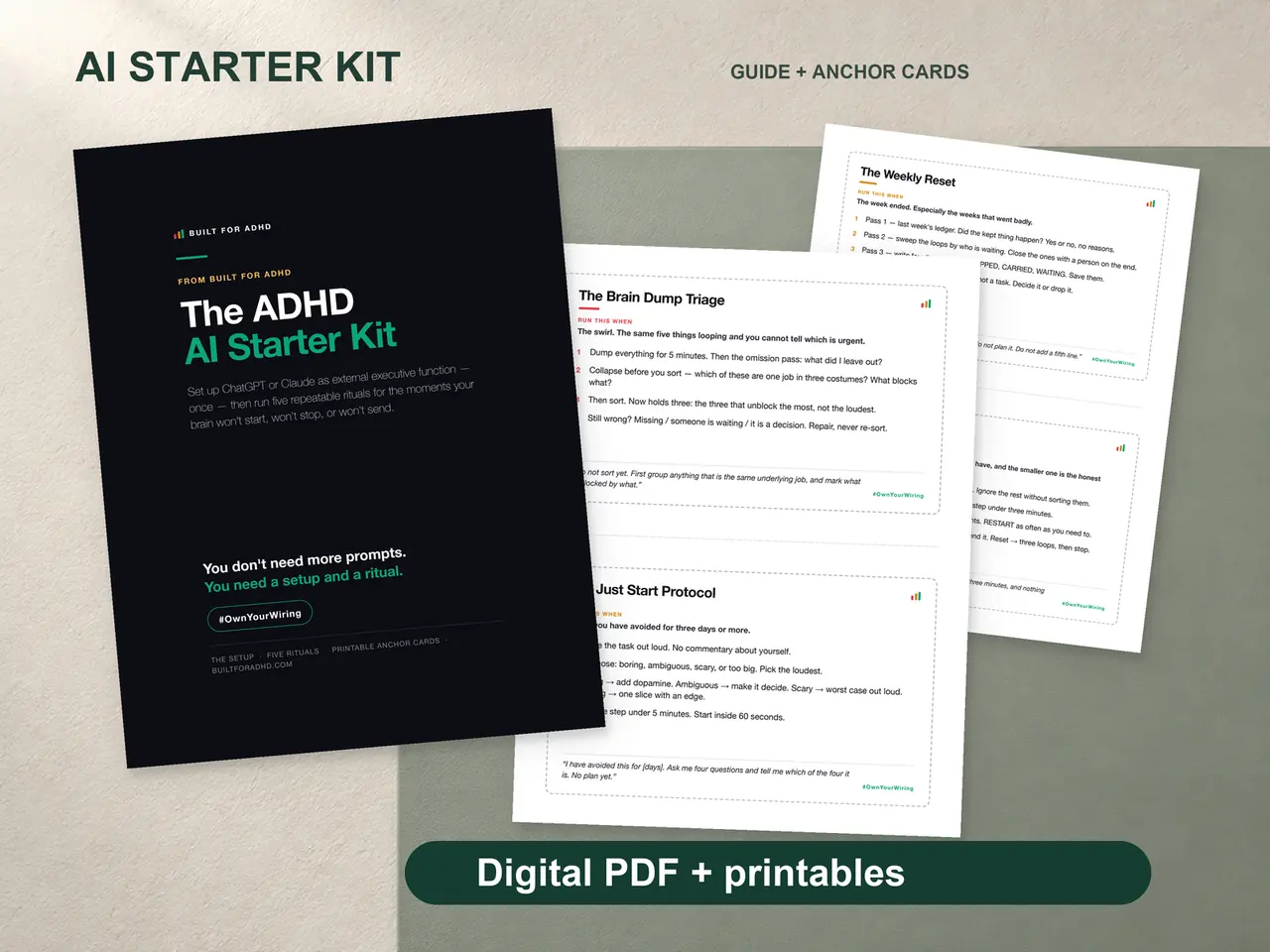
If you want the plan and the paper together: the ADHD AI Starter Kit pairs the setup and five rituals with printable anchor cards that keep each one at the point of performance. It is designed PDFs you print, not software. One purchase, no subscription. It will not make you start either. It will make sure that when you do, the plan is already on the desk.
One honest note
Everything here is productivity tooling, not treatment. Nothing on this page diagnoses anything, replaces therapy, or substitutes for care from a qualified healthcare provider — if executive dysfunction is significantly affecting your life, that conversation is worth having with a professional.
And the smaller note: AI makes the plan sharper. The paper makes it exist. Start with one prompt, print one page, and let that be enough for today.
More setup guides, techniques, and honest tool reviews live on the AI for ADHD hub.
Sources
- Pinto, A., Quilter, E., Vasikaran, J., Koerner, S., Chimonas, T., Nielsen, E., Marshall, P., & O’Hara, K. (2025). “‘A little bit of a life raft’ – Exploring the Use and Experiences of ChatGPT as a Support Tool among Adults with ADHD.” OZCHI ‘25. https://doi.org/10.1145/3764687.3764713
- Ara, Z., Rahim, I. B., Zhou, P., Yu, L., Esmaeili, B., Yu, L.-F., & Hong, S. R. (2025). “You Are Not Alone: Designing Body Doubling for ADHD in Virtual Reality.” arXiv:2509.12153. https://arxiv.org/abs/2509.12153
- Sophos, S. (2024). “Harnessing Artificial Intelligence to Live Better with ADHD.” CHADD, Attention Magazine. https://chadd.org/attention-article/harnessing-artificial-intelligence-to-live-better-with-adhd/
- ADDitude Magazine. “How to Use ChatGPT for Executive Function and ADHD.” https://www.additudemag.com/how-to-use-chatgpt-executive-function-adhd/