In this article
There is an envelope on my counter that has been there since June. I know what’s in it. I’ve opened it twice, read the first paragraph both times, felt something in my chest go flat, and put it back down exactly where it was — which is, I’ve come to understand, its own kind of filing system.
August makes this worse for everyone. School forms come home in a stack, the insurance letter that says this is not a bill arrives to say nothing, the rebate you meant to submit in May quietly hits its deadline. The pile grows the way it always grows — not by adding tasks, but by adding dread to the tasks already in it.
Here’s what changed it for me, and it isn’t a folder system. Admin tasks are not hard. They’re ambiguous, and ambiguity is the one fuel our brains can’t run on. The externalize-everything principle under every tool on this site applies here too — you just have to externalize the right thing. It was never the paperwork. It was the deciding.
Why the admin pile is different from every other pile
A doom pile is physical and unsorted. You can attack it with a timer and a trash bag because the work is obvious once you’re standing there. An admin pile looks the same from across the room and behaves nothing like it.
Pick up any item in it and you’re not holding a task. You’re holding an unanswered question in a task costume.
- “Fill out the school form” is really: do we qualify for the thing on page two, and what counts as ‘primary residence’ if we moved in March?
- “Deal with the insurance letter” is really: is this a bill, am I being charged twice, do I have to call someone?
- “Submit the rebate” is really: is the receipt still in the app, and is it worth forty minutes for $30?
Each of those is a decision, and decisions come out of a budget that’s already overdrawn by mid-afternoon. So the envelope sits. Not because you’re avoiding effort — you’d happily spend an hour on the actual filling out. You’re avoiding the twelve seconds of not-knowing that happen when you open it, and those twelve seconds have been costing you late fees and expired rebates for years. That’s the ADHD tax in its purest form: money lost not to a mistake, but to a pause.
And the reward at the end is nothing. No dopamine has ever arrived at the end of a correctly submitted rebate — you’re asking a brain that runs on now to work for a payoff of absence of future problem, which is about the least motivating currency there is.
Where AI actually earns its keep here
Not as a productivity app. As a thing that reads the document for you and tells you what it wants. That sounds small. It’s the whole bottleneck.
1. Make it translate before you decide anything. Photograph the letter, drop it into ChatGPT or Claude, and ask:
“Read this. In plain language: what is this document, what does it want from me, is there a deadline, and is there any money involved. Then tell me the single next physical action. If the document doesn’t say something clearly, say ‘not stated’ — do not guess.”
That last line matters more than everything before it. Left alone, these tools smooth over a gap with something plausible, and a plausible answer about your deductible is worse than no answer.
2. Have it write the ugly first draft. The email to the school office, the appeal letter, the “I was charged twice” message — those sit for three weeks because the first sentence is a tone decision, and tone decisions with an authority figure are expensive when your brain runs rejection-sensitive in the background. Ask for four sentences, neutral, no apology, and you’ll edit it in ninety seconds. Editing is a different job than starting, and you’re good at it.
3. Let it build the phone call script. Calls are the worst item in any pile because they’re live and unscripted. “Write exactly what to say to open this call, the three things I need to ask, and what to say if they tell me no.” Then read it off the page. I’ve cleared calls I deferred for two months this way, and the call took four minutes.
4. Pre-load the errand-within-the-errand. “This mentions form 8-B — what is it, where do I get it, and what do people usually forget on it?” Sitting down ready and then discovering you need a thing is what collapses the attempt.
The pattern under all four is the one from AI task breakdown: you’re not asking for a plan, you’re asking for the first physical motion, and you refuse to accept “gather documents” as an answer. “Text Mom for the policy number” is a start. “Gather documents” is a nap.
The twenty-minute admin block that actually works
Not a system. One repeating slot, and the rule is that you don’t do the paperwork in it — you decode it. Timer for twenty minutes, one item at a time: photo into the chat, get the four answers, write the single next action on the envelope in pen, put it back in the pile. That’s it. You’re allowed to not finish anything.
This works because unknowns were the heavy part. Nine envelopes is nine open loops your working memory holds all week. Nine envelopes with a sentence on each is a to-do list — annoying, finite, and now sortable by what you’ve actually got in the tank rather than by panic. Three will turn out to be two-minute items you do on the spot, because the reason they took three months was never the two minutes.
Do it at the energy level admin deserves, which is low — a perfect 3 PM task, since you don’t need your good hours for reading comprehension you’ve outsourced. And put any deadline on the calendar the moment you learn it exists. A deadline you know about and haven’t scheduled is the exact shape of a late fee.
The honest limits
Don’t paste your Social Security number, full account numbers, or your kid’s medical details into a chatbot. Crop the photo, black out the identifiers, ask about the structure of the document — it can explain what a term means without knowing who you are.
It will also be confidently wrong about specifics: dollar amounts, dates in fine print, which of two similar forms applies to you. Treat every number as a pointer to the line you should go read yourself. It’s a translator, not a source of truth, and anything legal, medical, or tax-shaped needs a human who’s accountable for being right.
And the decoded pile still has to get done. A beautifully annotated stack of envelopes is still a stack of envelopes. Put the three real ones somewhere your eyes actually go — a card on the desk, not a tab you closed — the same landing-spot problem as the voice brain dump.
Start with the worst envelope. Not the easiest — the one you’ve walked past longest, because it’s carrying the most dread per square inch, and the relief when it turns out to be a two-minute item is what gets you to open the second one. Photo, four questions, sentence in pen. The prompts above plus twenty-four more, sorted by what kind of stuck you are, are in the free prompt pack.
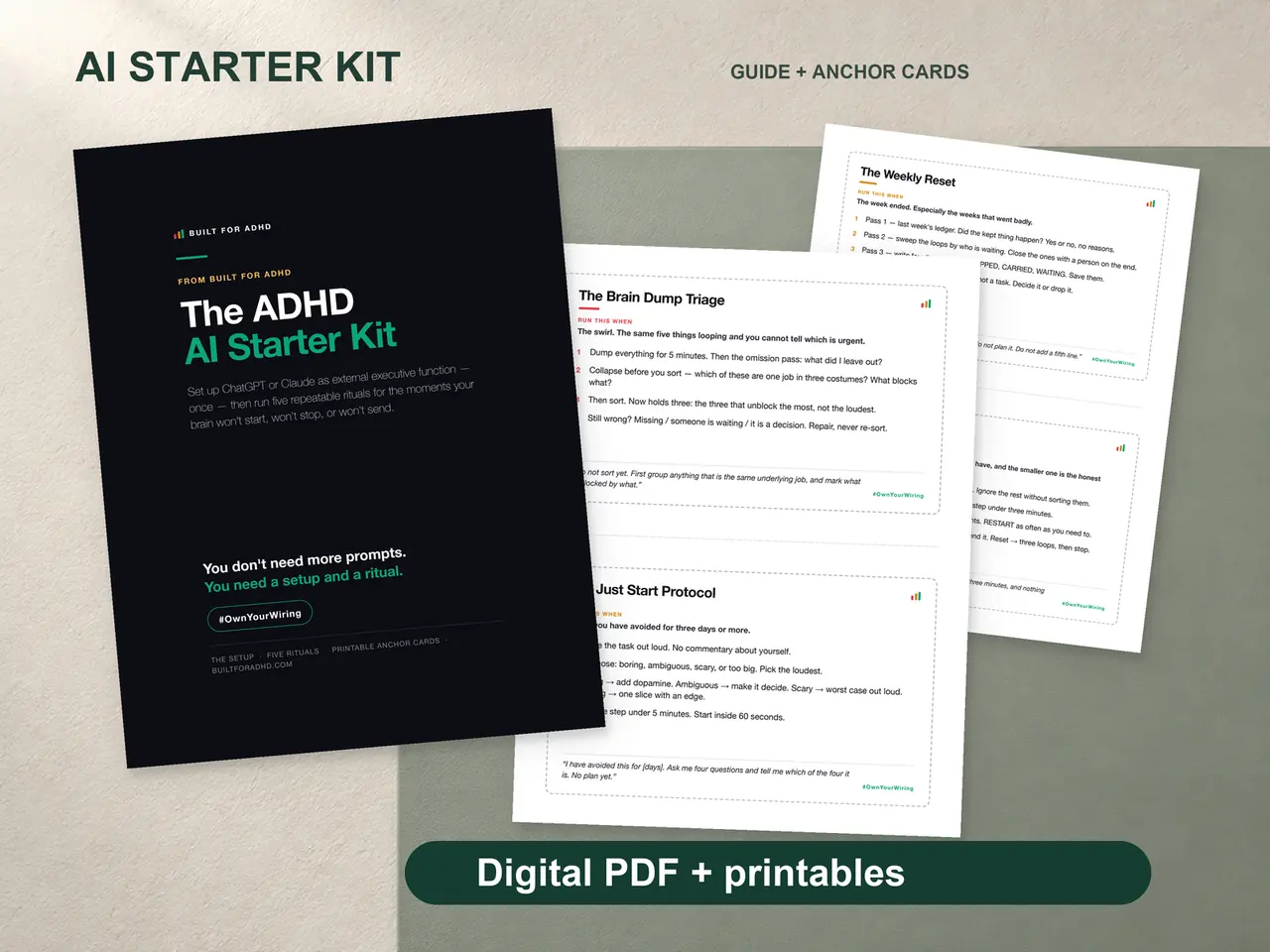
And if the decoding works but you keep re-explaining yourself to a blank chat window every single time — new conversation, same setup speech, same pep talk you didn’t ask for — that’s the gap the ADHD AI Starter Kit closes: the paste-once setup block so every reply comes back plain and unencouraging by default, the admin and triage rituals written out, and printable anchor cards so the next action ends up on your desk instead of in a tab. $27 once, no subscription.
Related tools
- ADHD tools for adults — the full externalize-everything toolkit
- ChatGPT custom instructions for ADHD — stop re-explaining yourself every session
- AI task breakdown for ADHD — turning “deal with it” into a first physical motion
- The tiny first step method — for the envelope you still can’t open
- The AI for ADHD hub — every setup guide, technique, and honest review in one place
Sources
- ADDitude Magazine, “Improving Your Working Memory: Executive Function and ADHD” — https://www.additudemag.com/working-memory-powers-executive-function/