In this article
Direct answer: AI can be genuinely useful external executive function for ADHD students — breaking an assignment into steps, starting the blank-page moment of an essay, turning a chaotic study session into a plan — as long as it’s doing the organizing, not the thinking. The line between “AI helped me start” and “AI did it for me” matters more for students than anyone else using these tools, so this guide draws it clearly instead of pretending it isn’t there.
This is written for the student side specifically, not the general “AI for ADHD” angle — assignments, deadlines, the specific chaos of a semester, not workplace or parenting use cases.
Why ADHD makes school harder in a specific way AI can actually address
The ADHD tax in school isn’t usually about intelligence or understanding the material. It’s executive function: breaking a three-week paper into a sequence you can actually start today, estimating how long something will take (badly, almost always), holding multiple deadlines in working memory at once, and starting the first sentence of something with no obvious first sentence. Those are the exact jobs a configured AI assistant is built to help with — organizing, sequencing, and starting — which is different from writing your paper or solving your problem set for you.
Where AI genuinely helps a student’s ADHD brain
Breaking an assignment into a real sequence. Paste the assignment prompt into ChatGPT or Claude and ask for a numbered sequence of small steps, not a summary. “Write a 5-page paper on X” becomes: pick a thesis, find three sources, outline in bullet points, draft the intro, draft body paragraph one — each step small enough to actually start. This is the same job AI task breakdown does for any overwhelming task, applied to schoolwork specifically.
Getting past the blank page, not past the writing. The single hardest moment in most assignments is the first sentence of a blank document. Ask the AI to generate a rough, bad, disposable first paragraph — not to use, but to react to. It’s almost always easier to fix something that exists than to generate something from nothing. Read it, disagree with half of it, and rewrite it in your own words. You end up doing the actual thinking; the AI just got you off zero.
Turning a study session into an actual plan. “I have a chem exam in four days and haven’t started — help me build a study plan” gets you a structure to react to instead of staring at a syllabus deciding where to begin. Combine this with a body-doubling session for the actual studying — declare the block, get one check-in, keep it moving.
Explaining a concept a different way. If a textbook’s explanation isn’t landing, asking an AI to explain the same concept with a different analogy or in simpler language is a legitimate use — this is tutoring-adjacent help, not academic dishonesty, as long as the understanding is genuinely yours afterward.
Sorting a messy pile of notes. If your notebook or notes app is a wall of half-finished thoughts from three different classes mixed together, pasting the whole unsorted mess into an AI chat and asking it to group by class and flag anything that looks like it needs an action is a legitimate organizational use — you’re not asking it to learn the material for you, you’re asking it to sort what you already wrote.
Where the line actually is
Here’s the part every “AI for students” article either skips or moralizes about instead of explaining plainly. The honest distinction:
- Using AI to organize, sequence, or start — legitimate, and arguably closer to what a good tutor or study-skills coach does than to cheating.
- Using AI to generate the actual content you submit as your own original work — not legitimate, will usually violate your school’s academic integrity policy, and more importantly, skips the part where you actually learn the material you’re being tested on later.
- The gray middle — using AI to check your own draft, or to generate a study outline you then verify against your notes — is generally fine, but check your specific school’s or professor’s policy, because these vary and are enforced unevenly. When in doubt, ask the professor directly what’s allowed; it’s a normal question in 2026, not a suspicious one.
If a task is specifically designed to test whether you can do something (an in-class exam, a skill you’ll need later without AI available), leaning on AI to bypass it costs you more than it saves — you’re renting an answer you’ll need to own later. If a task is testing whether the work got done and organized well (a lab report’s formatting, a bibliography), AI assistance on the mechanical parts is a reasonable use of the tool.
A useful gut check before you use AI on any given piece of schoolwork: would you be comfortable explaining to your professor, in plain language, exactly what you asked the AI to do and what you did yourself? “I asked it to break the essay into an outline, then I wrote every sentence” survives that test easily. “I asked it to write the essay and I changed a few words” does not — and deep down, most students already know which side of that line a given use falls on before they ask.
A workable setup for the semester
Paste something like this into a new chat or a Project/Gem at the start of the term: “I have ADHD. When I give you an assignment, break it into small sequential steps instead of a summary. When I’m stuck starting something, give me one small first action, not a full plan. Don’t write my actual academic work for me — help me organize and start it, then let me do the thinking and writing myself.” That one setup, done once, removes the need to re-explain yourself every time a new assignment lands.
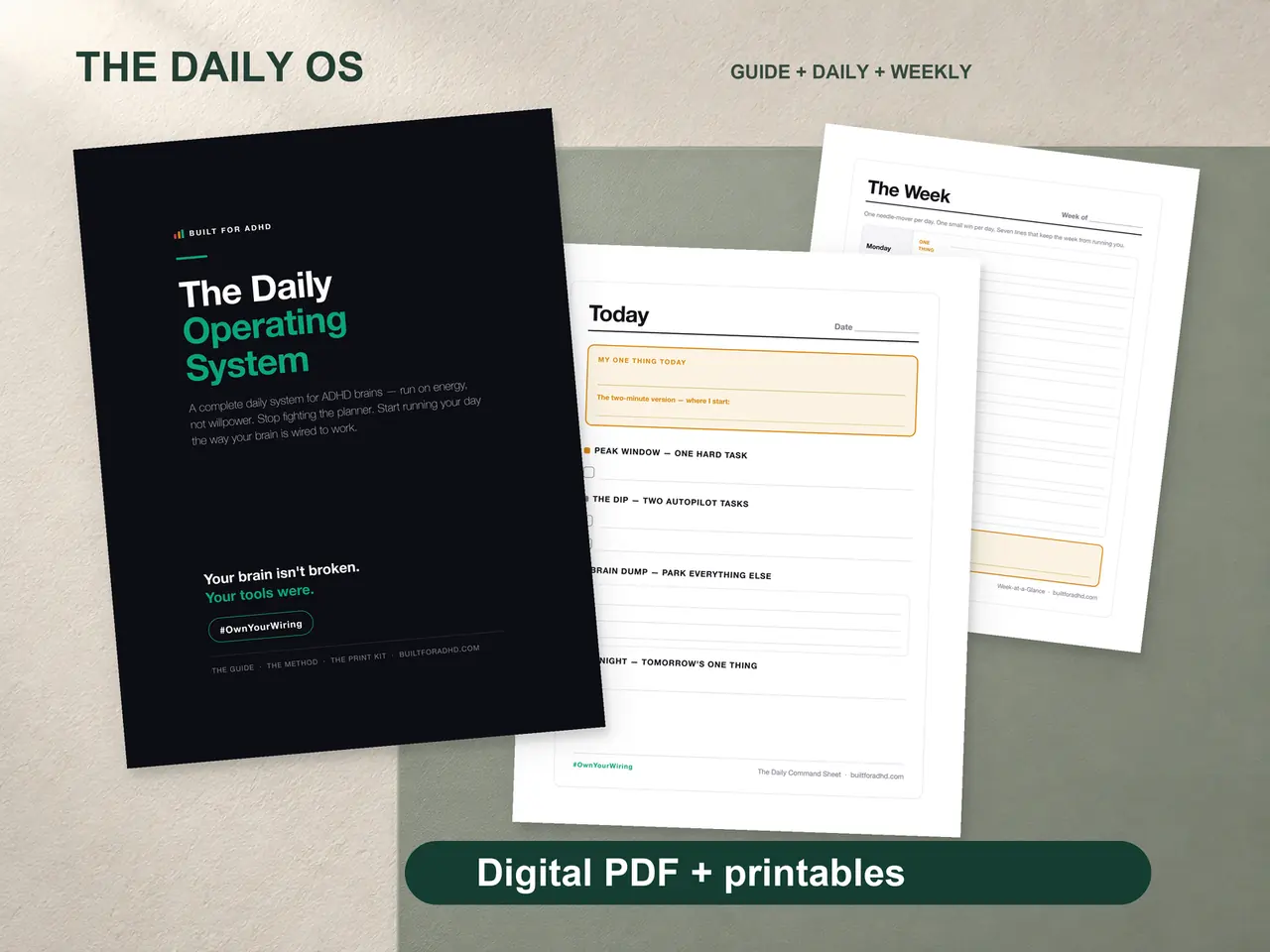
The organizing habit is worth building beyond just AI chats, too — a system for sorting assignments and deadlines by energy rather than by due date alone, the way the Daily Operating System does, means the AI’s step-by-step breakdown has somewhere consistent to land instead of getting lost in a new notes app every week.
FAQ
Is it cheating to use ChatGPT for schoolwork with ADHD? It depends entirely on what you’re using it for. Organizing, sequencing, and getting unstuck is generally fine and closer to tutoring than cheating. Generating content you submit as your own original work is not, and most schools’ academic integrity policies treat it as such — check your specific school’s policy since these vary.
Can AI help me with exam study specifically, not just assignments? Yes — turning a syllabus into a study schedule, explaining a confusing concept differently, and quizzing you on material you provide are all legitimate uses that don’t touch the line above, because the exam itself tests your own knowledge, not AI’s.
What if my professor doesn’t allow AI at all? Follow the policy as written — it’s specific to that class and enforced there. For classes with a stricter policy, you can still use AI for the parts that happen entirely on your own time and outside the submitted work, like organizing your week or clarifying a concept in casual conversation, as long as it’s not part of what gets turned in.
Do I need a paid AI subscription for any of this? No — the free tiers of ChatGPT and Claude cover everything in this guide. Paid tiers add convenience (faster responses, higher usage limits) but nothing here requires them.
Related
- AI Task Breakdown for ADHD — the general method this guide applies to schoolwork
- ADHD College Study Tips That Actually Work — the study-environment half of the picture
- ADHD Daily Operating System — $17, an energy-based system for holding deadlines and assignments in one place
- The AI for ADHD hub — every setup guide and honest review in one place
If you want the free starting point before buying anything, the free adult starter kit is the sampler.
Sources
- OpenAI Help Center, “ChatGPT Free Tier FAQ” — https://help.openai.com/en/articles/9275245-chatgpt-free-tier-faq
- Claude by Anthropic, “Plans & Pricing” — https://claude.com/pricing