In this article
Direct answer: AI is genuinely useful for the two hardest parts of cleaning and decluttering with ADHD — deciding where to even start, and staying in the room once the decision fatigue of “keep or toss” starts wearing you down. It’s not a substitute for physically doing the task, and it won’t lecture you about minimalism or make you feel bad about the doom pile. It just removes some of the decisions standing between you and starting.
If you’ve ever stood in a room that needs cleaning and felt genuinely paralyzed — not lazy, paralyzed — by not knowing where to begin, this is written for that exact moment.
Why cleaning is a decision-making task, not a physical one
The physical act of cleaning — wiping, sorting, carrying — isn’t usually the ADHD barrier. The barrier is the hundred small decisions cleaning requires: where to start, what counts as “done” for this pile, whether this specific item is trash or treasure, what to do with the thing that doesn’t have an obvious home. Each of those is a tiny decision, and ADHD brains run out of decision-making capacity fast, especially in a room that’s been avoided long enough to become genuinely overwhelming — the doom pile, the floordrobe, the surface nobody’s seen in weeks. By the time you’d need to make the fortieth decision, you’re mentally exhausted from the first thirty-nine, which is why cleaning sessions that start well often collapse halfway through.
AI is well suited to exactly this problem: it can make the small sequencing decisions for you, so your limited decision-making capacity goes toward the physical task instead of the planning.
Where AI genuinely helps
Turning “clean the room” into a sequence. Describe the room and the general mess — “my bedroom, clothes on the floor, a desk covered in mail and random stuff, dishes that migrated from the kitchen” — and ask for a specific order of operations, five to seven steps, each one small enough to picture actually doing. A vague goal like “clean the bedroom” has no natural entry point; a numbered list does.
The photo-to-plan version. Take a photo of the actual mess and describe what you see to an AI assistant (or use a model that accepts image input directly) — “here’s my kitchen counter, what’s the first three things to move” turns a wall of visual overwhelm into a short, specific starting instruction, which matters because the visual size of a mess is often what triggers the freeze in the first place, independent of how long the actual task would take.
Keeping decision fatigue from ending the session. When you hit the inevitable “I don’t know what to do with this specific weird object” moment mid-session, describe it and ask for a quick call: keep, donate, trash, or “put in a maybe box and revisit in 30 days.” Outsourcing that one decision to an external source, even a low-stakes one, can be enough to keep momentum instead of stalling on an object that isn’t actually important enough to deserve the mental energy it’s currently costing you.
A body double for the boring stretch. Cleaning has long stretches with no interesting decisions left — just repetitive physical work. The AI body-doubling protocol — declare the session, voice mode, check in every ten minutes — fits this specific moment well, especially with earbuds in while your hands stay busy.
Why “just make a list” advice usually fails here
Generic decluttering advice often suggests making a to-do list of areas to tackle. For ADHD brains, a flat list of rooms or zones tends to fail for the same reason any unordered list fails — it doesn’t tell you which item to do first, and picking the first item is exactly the decision that causes the freeze. A sequenced plan from AI solves a slightly different problem than a list does: it removes the ordering decision entirely, leaving only the doing.
What AI can’t do
It can’t touch anything. The physical labor is still yours, and no amount of a good plan changes how long carrying boxes or scrubbing a bathroom actually takes. It also can’t make the emotional weight of certain items lighter — sentimental clutter, a loved one’s belongings, anything tangled up with grief or identity is a different, slower category of decision that a quick AI prompt shouldn’t be rushing you through. For that kind of clutter, slow down instead of asking AI for a fast answer.
The 15-minute version, for when a whole session isn’t realistic
Not every cleaning moment has room for a full sequenced plan and a body-double session. Some days the honest goal is fifteen minutes, not a transformed room. For those, a shorter prompt works better: “I have 15 minutes and [describe the space]. Give me the single highest-impact thing to do in that time — not a full plan, just one thing that will make the biggest visible difference.” This produces a different kind of answer than the full sequence above — usually something like clearing one flat surface or handling one category of item — and it matters because a fifteen-minute win that actually gets done beats an hour-long plan that gets started and abandoned at minute twenty.
The same idea works for recurring low-grade mess, not just a full doom pile. If dishes pile up the same way every few days, ask AI to help you design a two-minute reset routine specific to that recurring pattern, rather than treating every occurrence as its own from-scratch cleaning project. A plan you only have to think through once, then repeat, costs far less executive function over time than solving the same problem fresh each week.
A starting script
“I’m looking at [describe the mess]. I have ADHD and get stuck on where to start and on small keep-or-toss decisions. Give me a short, specific first step — not the whole plan, just what to touch first — and when I tell you I’m stuck on a decision, give me a quick default answer so I can keep moving instead of freezing on it.” That’s the whole setup. Small first step, quick defaults on request, no lecture about how you got here.
FAQ
Why does cleaning feel so much harder than it should be with ADHD? It’s largely a decision-fatigue problem, not a physical-effort problem — cleaning requires many small judgment calls in a row (where to start, what’s trash, what’s not), and that kind of sustained micro-decision-making is exactly where ADHD executive function struggles most.
Can AI actually see a mess through a photo and help? Some AI tools accept image input directly and can describe what they see and suggest a starting point. If your tool doesn’t support images, describing the mess in a few sentences works nearly as well for this purpose — the value is in the sequencing, not the image analysis itself.
What if I get overwhelmed partway through, even with a plan? That’s normal and doesn’t mean the plan failed. Go back to the AI mid-session, describe exactly where you’re stuck, and ask for the smallest possible next step rather than trying to push through the original full plan.
Is this a replacement for professional organizing help, and do I need a special app for it? No specialized app is required — a general assistant like ChatGPT or Claude handles everything described here. For severe, long-standing clutter, especially anything tied to hoarding patterns, a professional organizer or therapist experienced in that area is a better resource than any chat-based tool; this guide is for everyday ADHD clutter, not clinical-level accumulation.
Related
- Photo to Plan: AI for the Mess You’re Staring At — the image-based version of this same method
- AI Body Doubling for ADHD — for staying in the room during the boring stretches
- ADHD Doom Piling: The Clutter Fix — the non-AI system behind the same problem
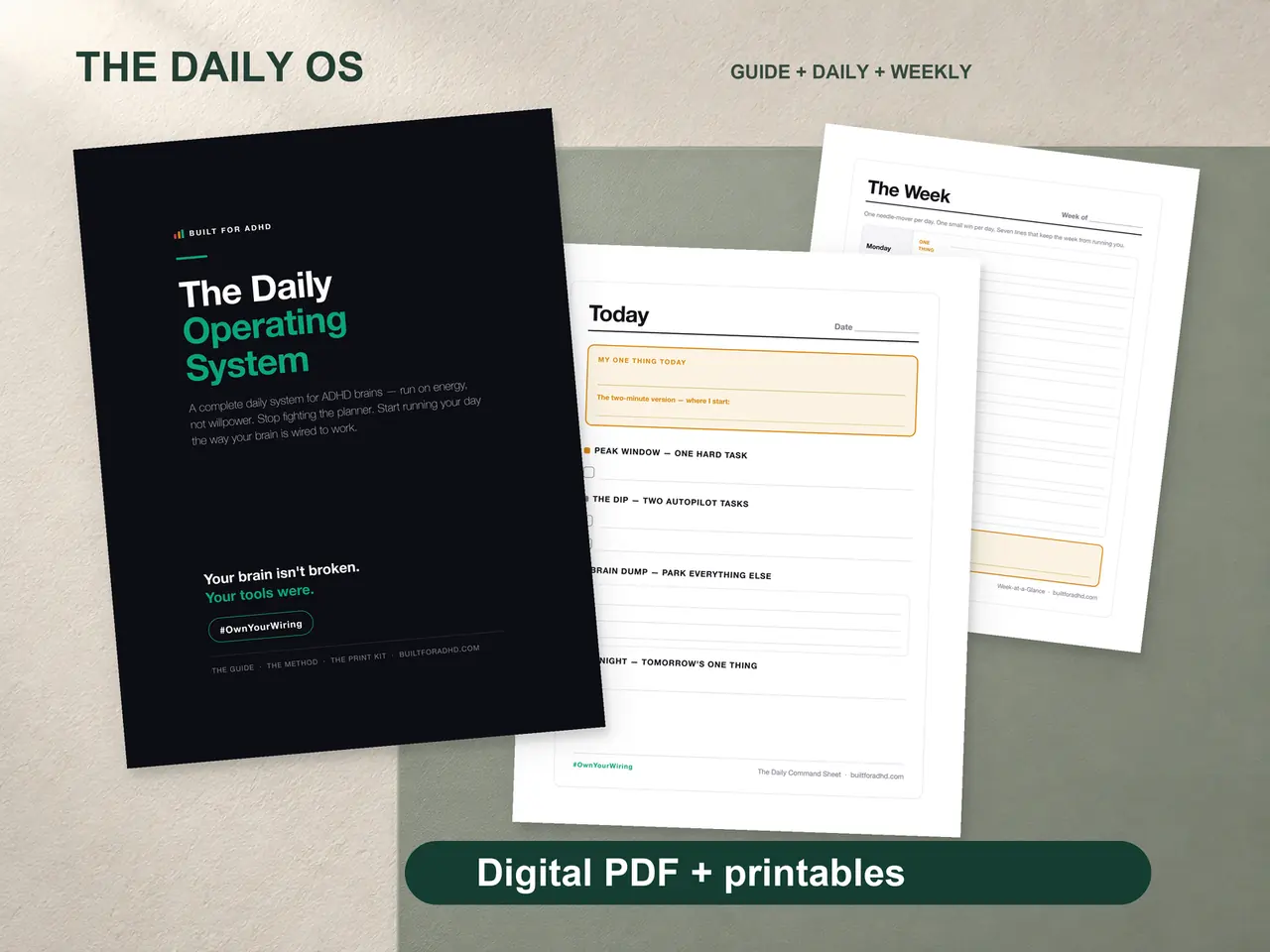
- ADHD Daily Operating System — $17, for keeping the room from sliding back into a doom pile
- The AI for ADHD hub — every setup guide and honest review in one place
If the whole household’s systems need the same fix, the ADHD Life System ($37) covers cleaning alongside everything else.