In this article
I have a client project that shipped, got a thank-you email, and sat unbilled for eleven weeks — not because I forgot the money existed, but because the part of my brain that files a project as “done” doesn’t overlap with the part that has to send an invoice. That gap is where a huge amount of ADHD entrepreneur revenue quietly dies. What actually closed it for me wasn’t more discipline. It was setting up ChatGPT as external executive function for the specific admin an ADHD business brain avoids — not a smarter to-do list, a place that does the thing you’re stuck on instead of reminding you it exists.
This is the entrepreneur-specific setup: the invoice, the ghosted follow-up, the 47 ideas competing with the one that pays, and the review that actually happens on Fridays instead of getting rescheduled into oblivion.
The invoice you keep not sending
Reminders don’t work on invoicing because a notification just asks you to convert an interruption into action, using the exact initiation machinery that dropped the task the first time. What works is handing over the facts and getting a finished draft back, so there’s nothing left to start:
Draft an invoice email for [client]. The project was [what it was], the amount is $[X], and it’s already three weeks late on my end. Two sentences, no apology paragraph, payment link at the bottom. Make it read like billing is normal, because it is.
Read it, drop in the real numbers, send it. The two-column tracker and standing billing day is still the system that keeps unbilled work from piling up in the first place — this is the tool that removes the actual friction the moment you sit down to bill.
The follow-up you ghosted
Every entrepreneur has one: the client who went quiet, the prospect you meant to circle back to nine days ago, the message that got more embarrassing to send the longer it sat. RSD turns a two-line follow-up into “am I bothering them, did I mess this up, maybe I should just let it go” — and that spiral is what actually blocks the send, not the writing. The fix is an RSD-safe draft: hand over the facts, strip your own anxiety back out of the wording, and send it before the spiral gets a vote.
I need to follow up with [client/prospect] about [what]. It’s been [X days] since I last heard from them and I’m overthinking whether to reach out at all. Draft a short, neutral follow-up — no apologizing for following up, no over-explaining the delay.
The draft reads calmer than what you’d have written from inside the spiral, because it isn’t carrying your anxiety about sending it — just the actual message.
The 47 ideas and the one revenue filter
Hyperfocus finds the interesting thing, not the paying thing, which is how you end up with twelve half-finished projects and a bank account that disagrees with your energy levels. Before you let a new idea eat a day, run it through a chat that only asks one question:
Here’s an idea I want to chase today: [describe it]. Does it move money in the next 30 days, is someone already waiting on it, and is it the thing I’m already three weeks into? If it’s zero-for-three, tell me straight and park it — don’t sell me on it.
Asking a chat to say no to you is oddly effective precisely because it isn’t attached to the dopamine of the new idea the way you are. The scored version of this exact question — with the worked example and the blind spots — lives in the Hyperfocus-to-Revenue Playbook if you want the full framework instead of the one-line version.
The weekly CEO review, as a standing chat
A Friday review that requires you to remember your own metrics is a review that stops happening by week three. Instead, make it a conversation where you supply the raw material and the chat does the sorting: dump cash collected, what’s outstanding, what shipped, what didn’t — unfiltered — and ask for the same three things back every week: what moved money, what’s the single overdue item, and what’s the one thing next week actually needs. ChatGPT Projects make this durable — a Project called “Friday Review” with standing instructions to always ask for those same three things means the ritual can’t drift, because the room holds the script instead of your memory. Projects are on every ChatGPT plan, free included, with room for the files a real review needs.
The RSD-safe send, generalized
Once the follow-up pattern above is working, use it everywhere a message feels disproportionately expensive to send: the scope-creep conversation, the price increase, the “no” to a client who’s used to hearing yes. The shape is always the same — state the facts plainly, ask for a draft that’s neutral instead of apologetic, and read it once before sending instead of nine times. That’s the missing bridge between thinking and doing for money conversations specifically: you already know what needs to be said, the tool just gets you from knowing to sent.
FAQ
Do I need ChatGPT Plus to run this? No. Custom instructions, memory, and Projects are all available on the free plan. Upgrade only if you’re running enough volume through it daily to hit usage caps.
Is this the same as the Hyperfocus Playbook’s 12 AI prompts? It overlaps in spirit — aiming AI at revenue instead of distraction — but this post is the standing-chat setup; the Playbook is the scored gate for deciding what to hyperfocus on in the first place.
What if I don’t trust myself to actually send what it drafts? Read it once, fix anything factually wrong, and send within the same sitting. The entire value collapses if the draft becomes a new thing to sit on.
Can I use this for client-facing work, or just my own admin? Both — the invoice and follow-up prompts work for any message you’re avoiding sending, business or client-facing. Just always read before you send; it doesn’t know your relationship history the way you do.
Does this replace bookkeeping software? No — it drafts the message and holds the review conversation. The actual ledger still belongs in whatever tracks your numbers; this is the layer that gets you to act on what the numbers say.
Sources
- OpenAI Help Center, “ChatGPT Custom Instructions” — https://help.openai.com/en/articles/8096356-chatgpt-custom-instructions
- OpenAI Help Center, “ChatGPT Free Tier FAQ” — https://help.openai.com/en/articles/9275245-chatgpt-free-tier-faq
- OpenAI Help Center, “Using Projects in ChatGPT” — https://help.openai.com/en/articles/10169521-using-projects-in-chatgpt
Related
- ADHD and forgetting to invoice clients — the tracker and billing day this pairs with
- Turning hyperfocus into revenue — aiming the energy this post helps you act on
- Managing clients with ADHD and RSD — the full pattern behind the RSD-safe send
- The free entrepreneur starter set — the CEO Daily System, free
- The AI for ADHD hub — every setup guide, technique, and honest review in one place
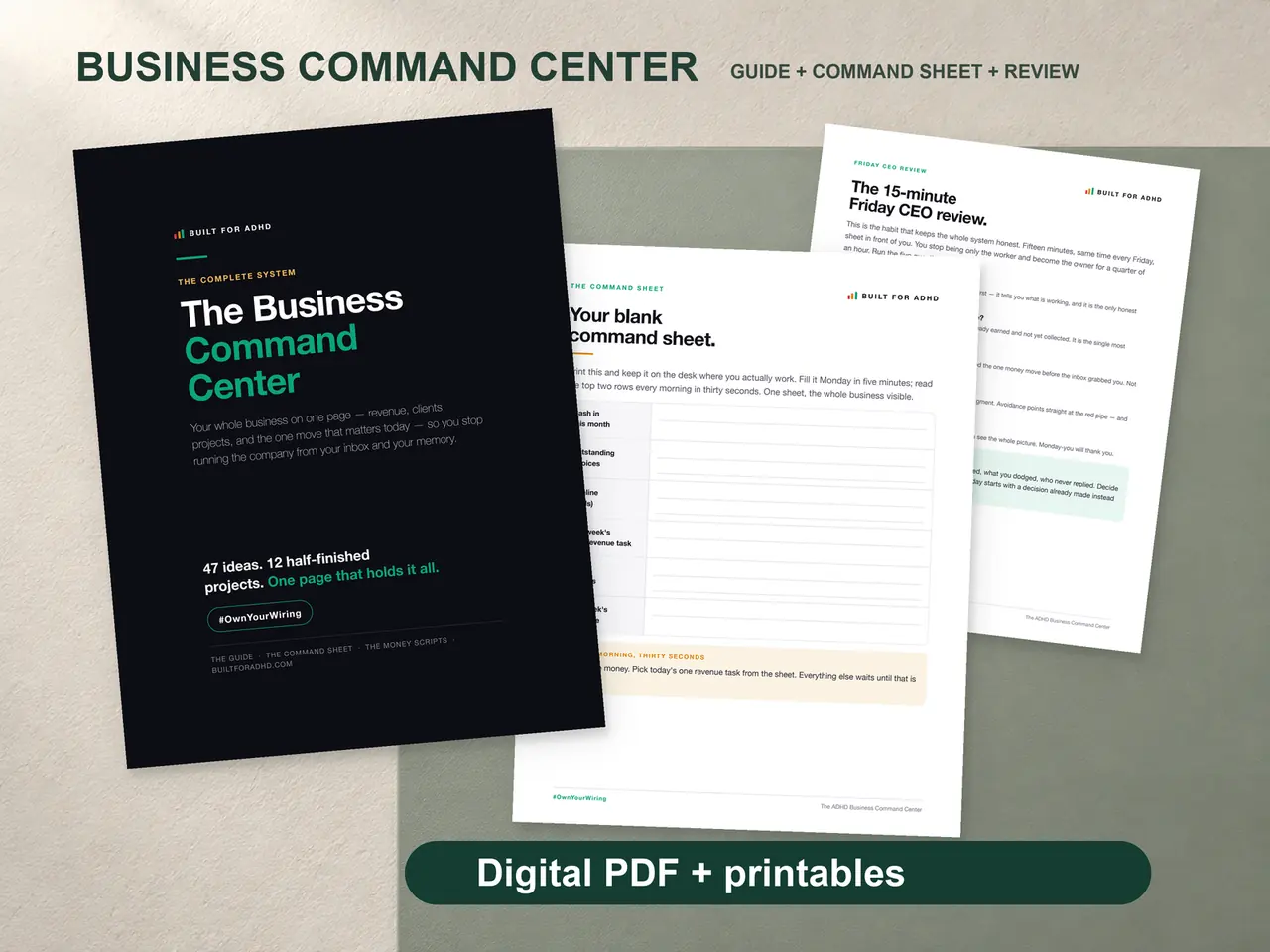
The full business-cockpit version — the Command Sheet, the Five Zones, the revenue traffic-light map, and copy-ready money scripts — is the ADHD Business Command Center, $19 once.