In this article
There is a person I would genuinely take a 2am phone call from, and I have not spoken to them since February.
Not because of a fight. I thought about them last Tuesday, warmly, for maybe four seconds while I was looking for my keys, and then the thought was gone and so was the rest of the year. When I finally do open the thread, the last message in it is going to be something of theirs I never answered, and the timestamp is going to do that thing to my chest.
That is the part people outside this get wrong. It reads as drifting apart. It is not drifting. The feeling never changed at all — only the thread went quiet, and then the quiet became its own obstacle.
The gap isn’t about caring, it’s about retrieval
Two mechanics do almost all of the damage here, and neither of them is about how much you like your friends.
The first: out of sight really is out of mind. A person who isn’t in front of you stops being a live item in your head — not demoted, just not loaded. The information is all still there. The path to it isn’t. It’s the same retrieval problem that makes a pile invisible until it’s suddenly urgent, running on a human being instead of a countertop.
The second: time blindness. “We just talked” is a feeling, not a measurement, and it survives absurd amounts of elapsed time. I have been genuinely confident that a conversation was recent and then found out it was nine months ago. Not exaggerated for effect — I checked the date and had to sit down about it.
Stack those two and no decision to stop talking to anyone was ever made, and yet here we are.
Why the reply gets harder the longer it waits
Then the third layer, which is the one that turns a gap into a permanent one.
The longer the silence, the bigger the apology you feel you owe. At two weeks it’s nothing. At three months you owe an explanation. At a year you owe an account — where you’ve been, what’s been going on, why you went quiet — and writing that is a whole project, and projects do not get done from the keys-in-hand state. So the thread stays closed, and every week it costs slightly more to open.
If rejection sensitivity is in the mix, you are also quietly certain they’ve read the silence as a verdict on them. They haven’t, mostly. But you’ll construct the version where they have, and that version makes the reply even more expensive.
This is exactly the unanswered-text pile mechanic with a longer timescale and higher stakes. Same fix shape too: stop trying to be a better rememberer, and put the remembering on a surface.
The three-ring list: twenty minutes, one page
Not a spreadsheet with a last-contacted column you’ll abandon in nine days — that’s the version I tried and it lasted a week and a half. One page, three rings, and the honesty is the whole value.
Set a timer for twenty minutes. Write down everyone you would actually be glad to hear from. Then sort them into three rings, by how often you want contact to happen — not how often you think a good friend should manage.
Ring 1 — the standing few. Three to five people, max. These are the ones where a week of silence feels wrong to you. Ring 1 gets a real cadence.
Ring 2 — the monthly-ish. Maybe six to ten. People you’d see happily and don’t need a running conversation with. A month between messages is not a failure here, it’s the design.
Ring 3 — twice a year, and that’s a real friendship. Everyone else. This ring is where the guilt lives, so say the thing out loud: two genuine contacts a year with someone you love is a friendship in good standing. It is not a downgrade. Most of my favorite people are Ring 3 and always were — I just didn’t have a word for it, so I read it as failing them.
Then give each ring a trigger instead of a schedule. A date you’ll miss is worse than no date. Ring 1 rides on something that already happens every week — whatever day your week already gets reset. Ring 2 gets one recurring reminder a month with two names attached to it. Ring 3 gets two dates a year and a list, and you work down the list.
The point of writing it isn’t organization. It’s that Ring 3 stops silently accumulating debt in your head, because the page says that gap is correct.
Sort by energy, not by obligation
Which ring someone belongs in should track what contact with them actually costs you, not what you feel you owe them. Some people are a two-hour recovery. Some people are easier than being alone. Sorting by what a thing costs rather than what it should cost is the difference between a list that survives a hard month and one that quietly becomes another thing you’re behind on — which is how every system that ignores energy eventually fails.
And people move rings. Someone’s Ring 1 for a stretch and Ring 2 after. That’s not a demotion, that’s a life.
Four re-entry scripts, no apology
Here is the rule that made this work for me, and it took an embarrassing number of years: do not explain the silence. The explanation is for you, not them, and it makes them manage your guilt on top of everything else. Name the gap in one clause, then move directly to something real.
Two to three weeks. Skip the preamble entirely.
“This reminded me of you —” then send the thing.
A few months.
“You’ve been in my head a lot and my phone is a black hole. How’s [the specific thing] going?”
One clause on the gap. Then a question with a detail in it, because the detail is the proof you were paying attention.
About a year.
“It’s been way too long and that’s on my end, not on anything. I’d genuinely love to catch up — are you around any evening in the next couple weeks?”
Owns it in one line. No account, no timeline, no list of what’s been going on. One concrete offer with an actual window.
Long enough that you’re scared to.
“I have no idea how to open this after this long, so: I miss you. No pressure to catch up on everything — can I just call you sometime?”
Saying the awkwardness out loud is what drains it. This one has never once gone badly for me, and I avoided sending it for years.
Then the low-energy versions, because a voice memo you send beats a thoughtful paragraph you draft and don’t. A reaction is not contact. A forwarded link with one line on it is. On a bad week, two lines is a complete message — the length you think is required is the story keeping the thread shut.
Turn off whatever is making your phone feel like a place you get yelled at, too. If opening it costs you something, you won’t open it to be warm at someone. Notification load is upstream of all of this.
What good looks like
Not a full inbox. Good is that the person you thought about while looking for your keys gets a two-line message that afternoon, because their name is on a page in a ring with a trigger on it, instead of in the general fog of people you’re failing.
Do Ring 1 tonight. Three to five names, one trigger, nothing else — the rest of the list can wait for a week you have twenty minutes in. If you want the weekly surface those triggers hang off, the free adult starter kit has the layout I run mine on.
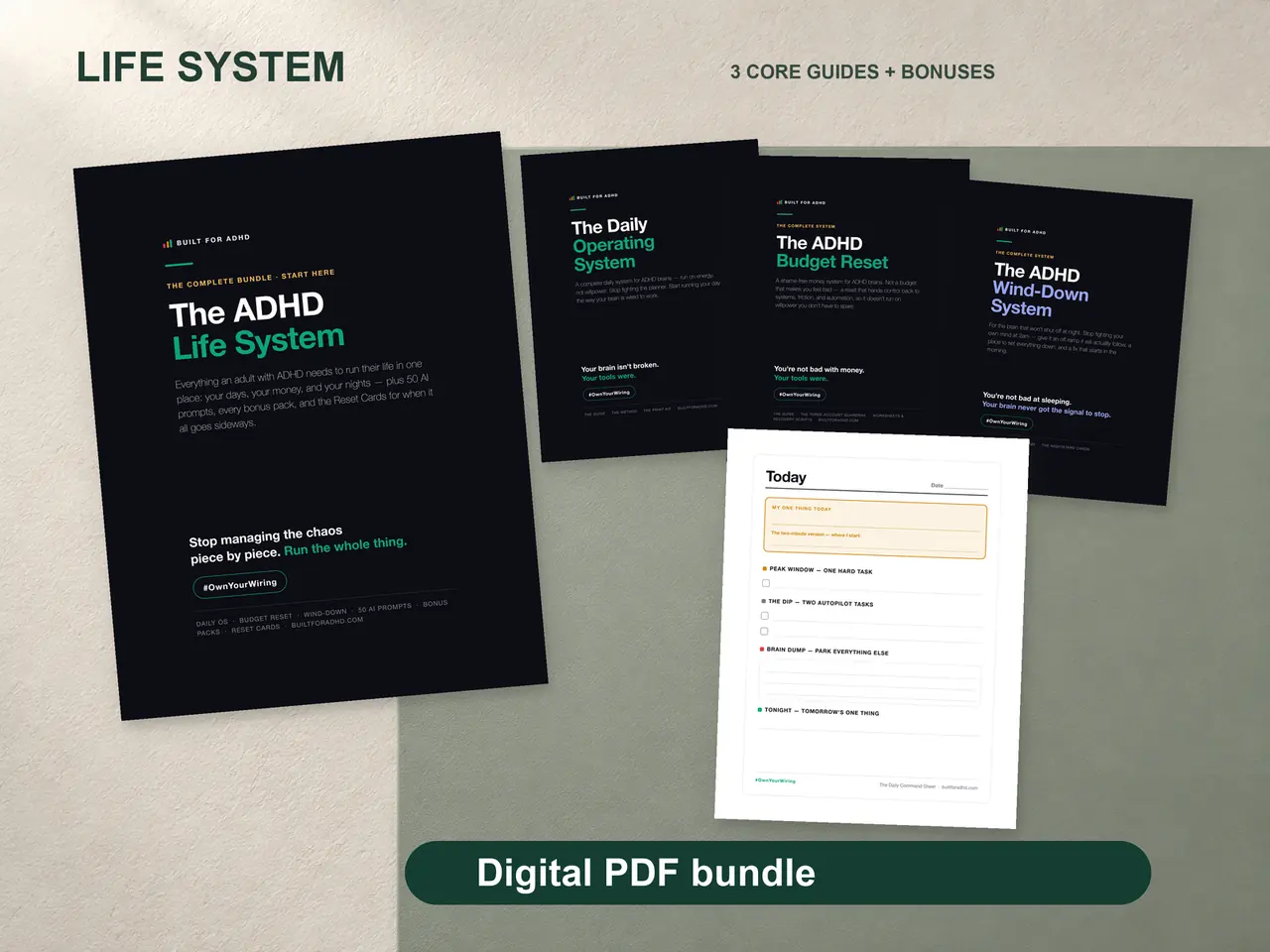
If you’d rather have the whole thing built — the weekly reset the Ring 1 trigger rides on, the day layout, and the reset cards for the weeks when everything including this falls over — that’s the ADHD Life System, $37. The three rings above cost you twenty minutes and a pen, and you should do them either way.
Related tools
- The free adult starter kit — the weekly surface the Ring 1 trigger hangs off
- ADHD late text replies — the same mechanic on a shorter timescale, with scripts
- What RSD feels like — why you’re sure they read the silence as a verdict
- ADHD time blindness — why “we just talked” was nine months ago
- ADHD notification overload — why your phone stopped being a place you go to be warm
- Energy-based task management — how to decide which ring someone belongs in