In this article
Direct answer: ChatGPT is a genuinely useful tool for the executive-function side of ADHD money problems — categorizing spending, catching patterns you can’t see because you avoid looking, drafting the money conversation you’ve been putting off — but it is not a financial advisor, and this post won’t tell you what to do with your money. It’ll show you how to use AI to see your money clearly enough to make your own decisions.
This is not investment advice, and nothing here should be read as personalized financial guidance. If you need that, a licensed financial advisor or credit counselor is the right resource. What follows is about the ADHD-specific logistics layer: tracking, categorizing, and talking about money without the shame spiral that usually derails the whole thing before it starts.
Why ADHD makes money specifically hard
Money management for ADHD brains runs into a specific combination: impulsivity that makes in-the-moment spending decisions feel disconnected from the bigger picture, working-memory gaps that make “how much do I actually have left” a genuinely hard question to answer without checking, and — maybe the biggest one — the ostrich effect, where anxiety about the numbers becomes a reason to avoid looking at them entirely, which of course makes the eventual reckoning worse. None of that is a discipline problem. It’s a mismatch between how ADHD attention works and how most money advice assumes attention works — steady, forward-looking, comfortable with delayed gratification.
Where ChatGPT genuinely helps
Categorizing a mess of transactions without judgment. Export a month of bank or credit card transactions (most banking apps let you download a CSV) and paste the list into ChatGPT, asking it to group spending into plain categories and flag anything that looks like a subscription, a duplicate charge, or an unusually large one-off. This does the tedious sorting work that avoidance usually prevents from happening at all — you don’t have to sit and manually categorize forty transactions to see the shape of where money is going.
A no-lecture read of your own patterns. Ask directly: “Here’s my categorized spending for the month. Without judgment or a lecture, tell me the three biggest patterns you notice.” A configured assistant can be told explicitly not to moralize — try adding “don’t tell me to just spend less, I know that already; just help me see the pattern clearly” if a response starts drifting toward generic advice.
Drafting the money conversation you’re avoiding. Whether it’s telling a partner about a purchase you’re anxious about, asking a family member to stop lending you money, or finally opening a bill you’ve been avoiding, drafting the anxious version first and asking for a calmer edit lowers the activation energy of a conversation that’s been growing heavier the longer it’s avoided.
A same-day reset after an impulse purchase. Instead of spiraling into shame after an impulse buy, describe what happened plainly and ask for a same-day, practical next step — return the item if that’s realistic, adjust the week’s spending elsewhere, or just log it and move forward. The goal is stopping the shame spiral from becoming its own time sink, not punishing yourself into a better system.
What this can’t do, and shouldn’t be asked to
ChatGPT cannot tell you whether to invest, which account to open, how to handle debt restructuring, or any decision that constitutes personal financial advice — those require a licensed professional who knows your actual full financial picture, something a chat window structurally cannot have and shouldn’t be trusted with for decisions of that size. What’s covered here is strictly the tracking-and-clarity layer: seeing what’s happening with your money, not deciding what to do about the parts that need expert judgment.
It also can’t replace the practical, physical guardrails that work well for ADHD-specific spending patterns — a separate account for guilt-free “fun money,” a cooling-off period before non-essential purchases, automatic transfers that remove the decision entirely. AI is good at the seeing-clearly part of money management; the acting-differently part usually needs a structural guardrail, not another conversation.
The specific shape of ADHD money shame
Money shame for ADHD adults tends to compound differently than for other spending struggles, because it’s rarely about one bad decision — it’s about the accumulated weight of avoided bills, unopened statements, and a running sense that “everyone else figured this out and I didn’t.” That belief is usually wrong (plenty of people struggle with money for reasons that have nothing to do with attention or impulsivity), but it’s a genuinely sticky one, and it’s the exact belief that keeps the avoidance going, because looking at the numbers means confronting evidence for or against it.
This is worth naming explicitly before you open your bank app: the point of the exercise above isn’t to prove you’re bad with money or good with money. It’s to get accurate information into view so you can make the next decision from reality instead of from dread. An AI assistant is useful here specifically because it has no emotional stake in your numbers — it won’t sigh, won’t remember last month’s overspending when you check in this month, and won’t treat a hard week as evidence of a permanent character trait the way your own inner monologue might.
A setup for the ongoing habit
Rather than a one-time export, the highest-value habit is a short, recurring check-in: once a week, paste in the last few days of transactions (or describe them from memory if that’s realistically what you’ll do) and ask, “What’s one thing worth noticing this week — no lecture, just the pattern.” Fifteen minutes on a fixed day beats an ambitious daily tracking habit that gets abandoned after four days, which is the failure mode most budgeting advice runs into with ADHD brains specifically.
Pairing this with a structured, guilt-free spending system — separate accounts for bills, spending, and fun money, so there’s less to track manually in the first place — means the AI check-in has something concrete to react to instead of a blank financial picture every week.
FAQ
Can ChatGPT give me investment or financial advice? No, and it shouldn’t be used for that. Use it for tracking, categorizing, and pattern-spotting — not for decisions about investing, debt strategy, or anything requiring a licensed advisor’s judgment.
Is it safe to paste my bank transactions into ChatGPT? Remove or mask account numbers and other identifying details before pasting anything financial into any AI chat, the same caution you’d use with any sensitive information online. Category names and amounts alone are usually enough for the pattern-spotting use case above.
Will ChatGPT judge me for bad spending habits? It’s a language model, not a person — but its default tone can drift toward generic advice-giving. Explicitly ask it not to lecture you, and it will generally follow that instruction well.
What if I’ve avoided looking at my finances for months and don’t know where to start? Start with the smallest possible version: one account, one week of transactions, one plain question to the AI about what it notices. You don’t need the full picture on day one — you need enough to break the avoidance pattern, and a small first look does that better than an ambitious full audit you’re likely to abandon partway through. This is a complement to a tracking app’s numbers, not a replacement — the AI adds the conversation and the pattern-spotting a raw dashboard doesn’t.
Related
- ADHD Money Avoidance: The Ostrich Effect — the pattern this guide is built around addressing
- How to Budget with ADHD Without Hating Every Second — the structural side of the fix
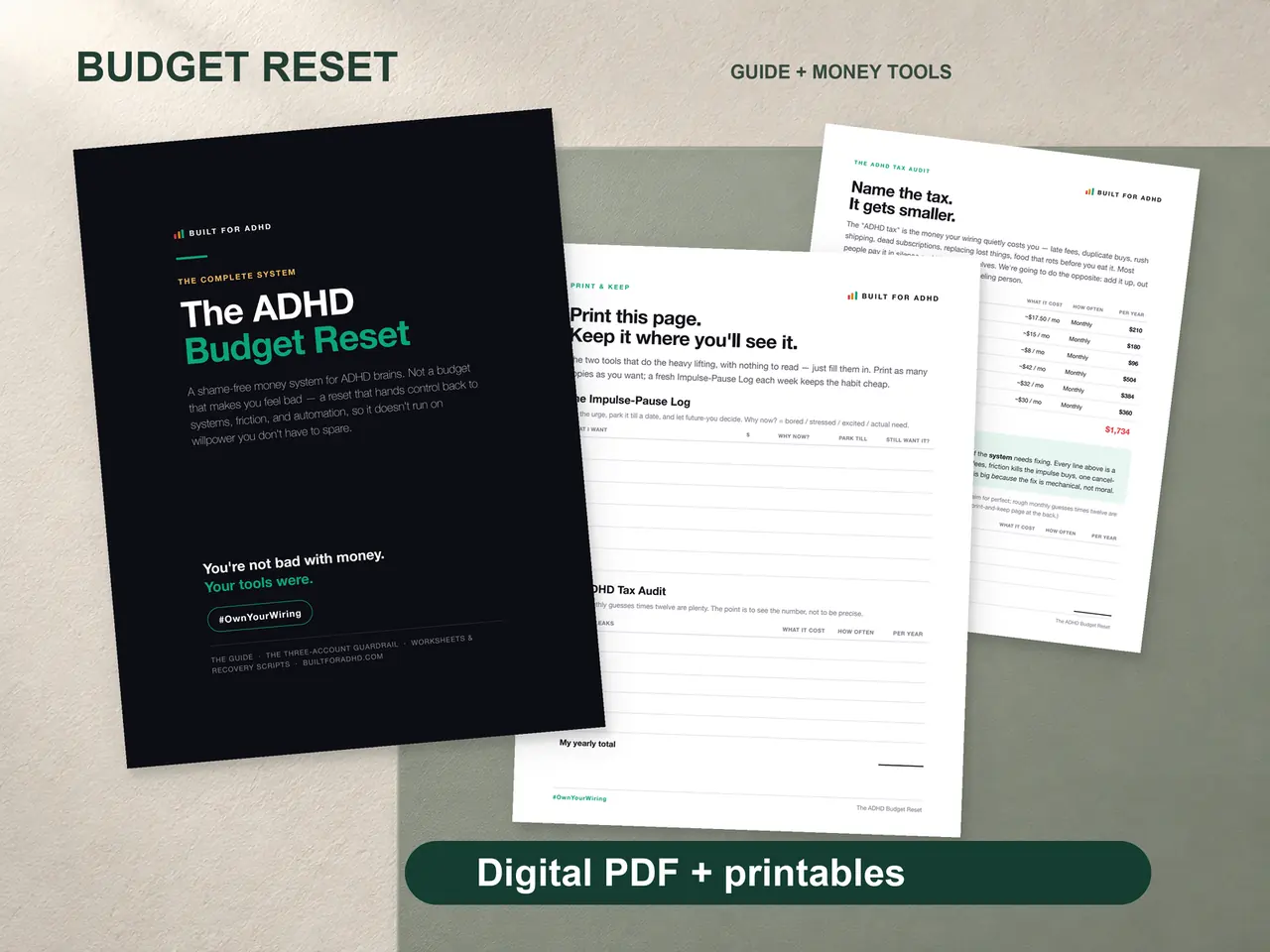
- ADHD Budget Reset — $7, the shame-free system this AI habit pairs with
- The AI for ADHD hub — every setup guide and honest review in one place
If the bigger picture feels overwhelming, the ADHD Life System ($37) bundles the money reset with the rest of daily structure.