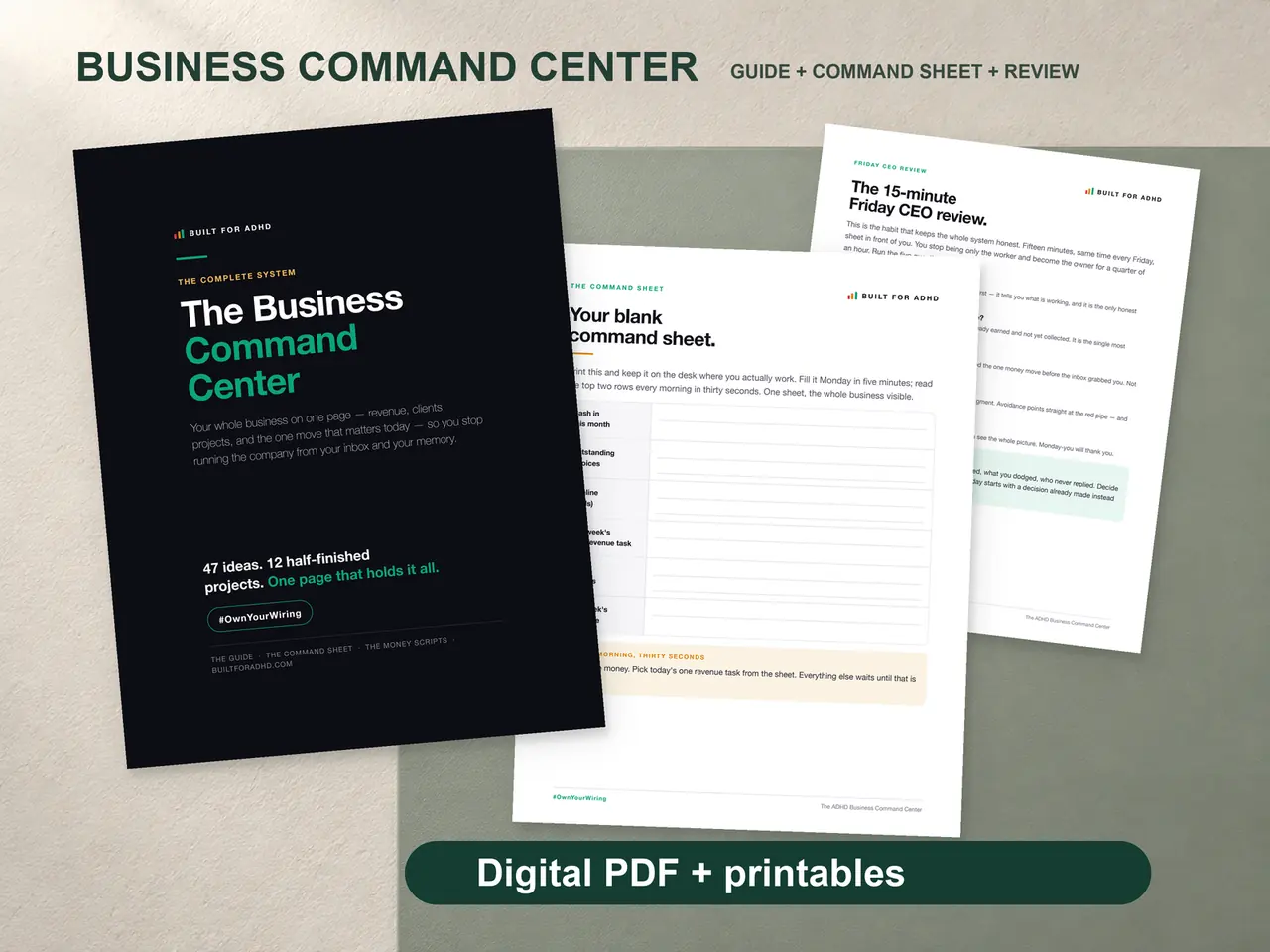
This is the business version of a command center, not the family one — if you’re looking for the household board that tracks chores and appointments, that’s the ADHD Command Center for families. This one is for your business: one printed page that holds revenue, pipeline, and projects, sorted so you can see the whole thing in thirty seconds instead of piecing it together from your head, your inbox, and a shoebox of receipts.
One Page, Three Things a Solo Business Actually Needs to See
Most business advice assumes a team: someone doing sales, someone doing books, someone reminding you what’s overdue. Solo, you’re all of them, and the ADHD tax on running a business alone is that nothing gets tracked unless you personally remember to track it — which is exactly the thing your brain doesn’t do reliably. This page is one piece of the wider self-employed organization system; read that one too if the business is only part of what’s falling through the cracks.
A business command center collapses the chaos down to three things on one page: what money is coming in and what’s still owed, what work is actually in the pipeline versus just talked about, and which of your current projects deserve your best hours today. Everything else is noise until one of those three needs your attention.
None of this requires software, a dashboard, or a login you’ll forget the password to by next month. It’s one page you print, fill in by hand, and glance at — because the whole reason business tracking falls apart for ADHD founders in the first place is that it lived somewhere you had to remember to open.
The Revenue Line
Revenue is the one number a solo business can’t afford to lose track of, and it’s also the easiest one to lose track of, because collecting money is an admin task and ADHD brains defer admin tasks by instinct. The fix isn’t a better memory — it’s a single revenue traffic-light row you fill in without thinking: green for paid, yellow for invoiced and waiting, red for work that’s done but never got billed.
Forgetting to invoice clients is its own well-worn ADHD pattern — you did the work, the invoice just never left your head — and the standing billing day in that post is the same fix in a different format: same problem, same solution, whichever version sticks for you.
The Pipeline
Pipeline is where solo businesses quietly starve. You send one round of outreach, get no reply, and move on to the next shiny thing rather than following up — not because the lead went cold, but because following up is a task with no built-in deadline, and tasks without deadlines are the ones ADHD brains drop first.
A pipeline row for every live conversation, with a next-action date next to it, turns “I should probably follow up with them” into a specific line you either did or didn’t do today. A cold outreach follow-up system is the deeper version of this same fix, for anyone whose pipeline is really a graveyard of first messages.
The point of writing the pipeline down isn’t to make you feel behind — it’s the opposite. A visible list of five live conversations is a lot less overwhelming than a vague sense that you’re “bad at sales,” because five specific next-actions is a to-do list, and a to-do list is something an ADHD brain can actually work through.
Energy-Sorted Projects and the Idea Parking Lot
Not every hour is the same hour. A command center sorts your live projects by the energy they need — the deep-focus project that needs your best morning, the administrative project you can do half-asleep — so you stop trying to do invoicing during your one good hour of the day and creative work during the slump.
New ideas get their own lane entirely: the parking lot. Every idea gets written down and rated for revenue potential and effort, then left there — not folded into your active projects, where it would derail whatever you were actually supposed to be finishing. The parking lot’s entire job is to make an idea feel captured enough that you can let go of it today.
Two more leaks worth closing while you’re at it: the inbox that never gets to zero is usually where half your pipeline is quietly buried, and the wider pattern behind all of this — why a solo business runs on hyperfocus and adrenaline instead of a system — is covered in the ADHD entrepreneur productivity system.
The 15-Minute Friday Review
A command center only stays true if something updates it, and the update doesn’t need to be daily. Fifteen minutes on a Friday — check what came in, check what’s still owed, pick the one thing next week actually needs — keeps the whole page honest without asking for more attention than a solo business owner running the whole show can spare.
What This Looks Like on Paper
The ADHD Business Command Center puts all of this on one printed page: the Command Sheet, the Five Zones your business tasks sort into, the revenue traffic-light map, the idea parking lot, and the 15-minute Friday review, plus money-avoidance scripts for the payment emails you keep not sending. It’s the business half of the wider self-employed organization system.
If you want to try the underlying idea before anything else, the free CEO daily system picks your one revenue-moving task for the day, which is the smallest version of everything above.
You don’t need to become a different kind of business owner. You need one page that tells the truth about revenue, pipeline, and priority — so the business runs on what’s actually happening, not on whatever your brain hyperfocused on this morning.