In this article
I made fourteen pieces of content in one weekend once. Filmed, edited, captioned, thumbnails done. It was one of those weekends where the work stopped feeling like work around hour three and I just kept going, and by Sunday night I genuinely believed I had solved content forever.
I published all fourteen inside nine days. Then I made nothing for five weeks.
That’s the pattern, and I want to name it precisely, because the way most advice describes it is wrong. The problem was never that I couldn’t produce. I produced more in forty-eight hours than most people manage in a month. The problem is that I let production and publishing happen at the same speed, so the moment the wave went out, so did the feed.
”Consistency” is a word built for a brain you don’t have
Every piece of advice about posting consistently assumes a steady daily trickle of output. Show up every day. Small reps. Do a little bit each morning.
That model requires your capacity to be roughly the same on Tuesday as it was on Saturday, and mine is not. Mine is a wave. Some weeks I have four ideas before breakfast and some weeks forming a sentence feels like lifting furniture, and no amount of willpower has ever flattened that curve — the same way sorting tasks by energy instead of by clock time is the only version of a to-do list that has ever survived contact with my actual week.
So stop trying to flatten it. The output is fine. What’s missing is a buffer between the making and the publishing, so the feed doesn’t have to feel your bad weeks.
The content bank: four columns, one page
This is the whole system, and it is boring on purpose.
Idea · State · Format · Publish date
State has exactly three values: raw, drafted, ready. Raw is a sentence you scribbled. Drafted is made but unfinished — filmed but not edited, written but not proofed. Ready means it could go out today with zero further decisions.
That third column is the load-bearing one, because “ready” is a promise to your future self who has no energy and no memory of what you meant. If something is marked ready and you open it and there’s still a decision in it — a title to pick, a thumbnail to choose — it wasn’t ready, and you have just handed your worst day a task built for your best one.
The bank lives in one spreadsheet or one note. Not a project management tool with statuses and boards. A tool you have to maintain becomes a place you go to feel behind, and you will abandon it during exactly the week it was supposed to carry you.
Two modes, and they never share a day
Make mode is when the wave is in. You are filming, writing, recording, drafting. Everything you produce goes into the bank as drafted or ready. Nothing gets published today. This is the hardest rule in the system and the entire thing depends on it.
Ship mode is fifteen minutes, on a fixed day, whether or not you feel like it. Open the bank, take the top ready item, post it, mark it gone. That’s the job. Ship mode requires no creativity, no taste, and no ideas — because all of that was spent weeks ago by a version of you who had it to spare.
The mistake I made for years was letting make mode publish as it went. It feels efficient. It’s the same instinct that says finish the thing while it’s hot. But publishing during a wave means the bank never fills, and when the wave goes out the feed goes silent on the exact same day — which is when the algorithm, and the audience, and your own self-image as someone who follows through, all take the hit at once.
The buffer number: three weeks
Pick a posting cadence you can actually hold — twice a week is plenty, and it beats a daily promise you’ll break in a month — then bank three weeks ahead of it.
Three weeks at two posts a week is six ready items sitting in the bank. That number is not arbitrary in my experience: it’s roughly how long a bad stretch lasts for me before something shakes loose. Yours might be two weeks or five. Track it for a couple of months and you’ll find out what yours is, which is a far better number than the one I just gave you.
Below the buffer, you’re in make mode by default. At or above it, you can spend a good day on something else entirely — the client work, the launch, the thing that actually pays. That’s the other quiet win here: a full bank is what makes it possible to aim a hyperfocus wave at revenue instead of at content, because content is already handled for the next month.
Have a floor format
There will be a week where the bank is empty and ship day arrives anyway. Decide now, in writing, what you post on that day.
Mine is a single unedited take, no cuts, filmed at whatever desk I’m at. Yours might be one paragraph, or a photo with three sentences, or a voice memo you barely trim — talking it out is usually cheaper than writing it out when you have nothing left in the tank. The format doesn’t matter. What matters is that it costs you almost nothing and it is decided in advance, because the whole reason streaks die is that the empty week forces you to invent a plan at your least resourced moment.
The floor format is not your best work. It is not supposed to be. It’s the thing that keeps the promise while the wave is out.
The part where it feels like it’s not working
A bank means a gap between making a thing and it going out. Sometimes weeks. That gap is deeply uncomfortable if silence from an audience already lands like a verdict rather than a scheduling detail, because you will publish something on a Tuesday that you made three weeks ago and no longer feel excited about, and the flatness of that will read as evidence the thing is bad.
It isn’t. It’s just old to you. Everyone seeing it is seeing it for the first time, and the pieces of mine that traveled furthest were almost always ones I’d cooled off on completely by the time they went out.
Also: the calendar will lie to you about how long you’ve been going. “I’ve been posting consistently for a while now” is not a feeling you can trust when time doesn’t register as passing. Put a tally in the bank. Count the shipped rows. That’s the record, not the vibe.
What to do in the next ten minutes
Open one blank page. Make four columns. Now go through your drafts folder, your camera roll, your notes app — every half-finished thing you’ve abandoned — and put each one in as a row with an honest state.
Most of them will be drafted, not ready. That’s the actual finding, and it’s a good one: you don’t have a production problem, you have a pile of nearly-finished work and no last mile. Pick the two closest to done, finish them today, mark them ready, and you have a two-week buffer before dinner.
Then put ship day on the calendar as a repeating event before you close the tab.
If you want the rest of the solo-business scaffolding around this — where the week’s priorities live so content isn’t competing with invoicing for the same hour — that’s the free entrepreneur starter set, about ten minutes to set up.
You don’t need to become someone who produces evenly. You need a bank deep enough that nobody can tell which weeks were the good ones.
Related tools
- Hyperfocus-to-Revenue Playbook — $9: how to aim a wave at the thing that pays, and what to do when it eats the week instead
- The ADHD entrepreneur’s productivity system — the layer this sits inside
- Turning hyperfocus into revenue — what to point make mode at when the bank is already full
- Energy-based task management — sorting by capacity instead of clock time
- The ADHD cold outreach follow-up system — the same buffer logic, applied to leads
- Self-employed organization tools — the printable versions
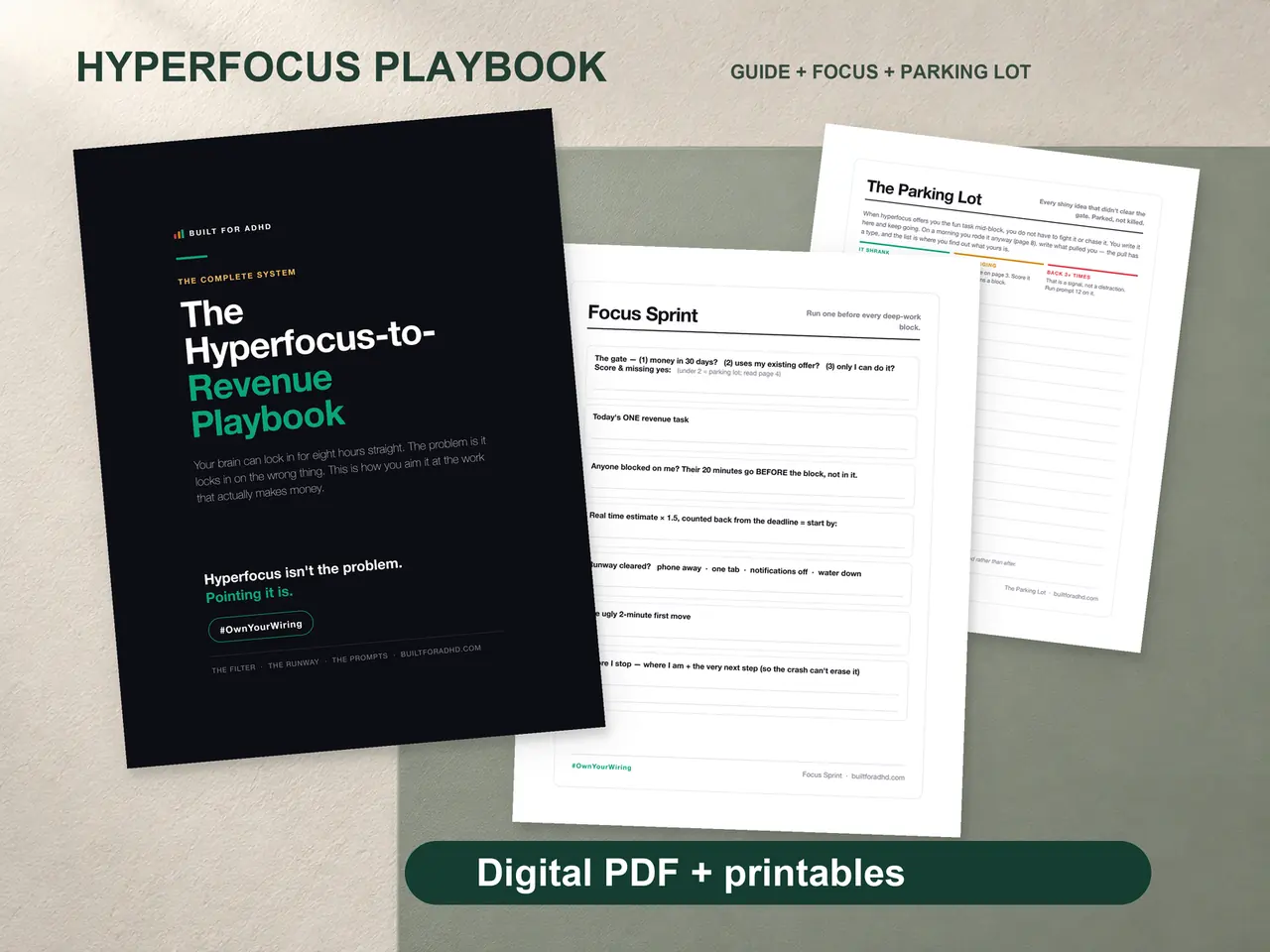
If you want the version that deals with the wave itself — how to catch one, where to aim it, and how to triage the week after it crashes — that’s the Hyperfocus-to-Revenue Playbook. $9, sixteen pages, plus three print-and-keep desk sheets. It won’t make you consistent. It’ll make your good days count for more.