In this article
I bought the spinach with real intentions. Two weeks later I opened the crisper drawer and found something that used to be spinach and is now mostly a liquid, and I stood there doing the math on what that bag cost, and then doing the math on how many bags this year, and then closing the drawer because that math was not improving my morning.
Here’s the part that took me too long to understand: I did not forget that I wanted to eat vegetables. I forgot that the vegetables were in the house. Those are completely different failures, and only one of them gets fixed by trying harder at the store. (The planning half of this lives in my ADHD meal planning guide.)
The back of the fridge is functionally a different building
An ADHD brain runs on what’s in front of it. Not on what it knows. You can know, in a general factual way, that there is chicken in there, and still stand with the door open at 6:40 deciding between the two things you can actually see.
So the fridge quietly becomes a storage unit with a visible front row and an invisible everything-else. The front row gets eaten. The back row gets bought, stored, aged, and thrown out — and then re-bought next Saturday, because the shopping list also got written from memory, and memory only holds the front row too.
It’s the same mechanic that builds a doom pile: the stuff isn’t lost, it’s just out of the retrieval path. A pile you walk past twelve times can stay genuinely invisible right up until it’s a crisis. A yogurt at the back of the second shelf can too.
And there’s a timing layer underneath it. Produce runs on a clock, and time blindness means “I’ll use that this week” and “I bought that eleven days ago” register as roughly the same sentence. Nothing in the fridge announces itself until it announces itself badly.
This is a line item, not a character flaw
Before the fix, the reframe, because the shame here does real damage and buys you nothing.
Throwing out food is one of the most expensive and least discussed entries on the ADHD tax — the money that leaves because of how the brain handles retrieval and time, not because of how much you care. Nobody buys raspberries hoping to compost them. You bought them with the same optimism that writes a fourteen-item to-do list for a Tuesday.
So the fix isn’t buying less hopefully. It’s building a fridge where the food is visible on the day it needs eating. Sight, not memory. That’s the whole design.
Part one: the eat-first bin
One clear container. Eye level, front and center, on the shelf you look at first when the door opens.
Everything with a short clock goes in it. Opened things, the half onion, the leftovers, the berries, the bag of salad that is three days from betrayal. Nothing goes behind it and nothing stacks on it.
That bin is now the only place you have to look when you’re hungry and have no plan. One container, one decision, instead of a scan of four shelves that ends in ordering something. If you already struggle with deciding what to eat at all, this shrinks the field from everything to six things, which is the part that was actually breaking.
Buy the clear bin. Not a nice one — a clear one. The whole function is that you can see into it without moving it.
Part two: keep the front row clear
The front row of each shelf is prime real estate and it should not be occupied by condiments.
Push the long-life stuff — jars, sauces, the mustard collection that has achieved sentience — to the back and the door. The front of every shelf holds only things that need to be eaten this week.
That’s it. That’s the rule. You are not organizing your fridge. You are moving the things with a deadline into the only zone your brain reliably reads.
Part three: photograph the fridge before you shop
Sixty seconds, standing at the open door, phone out. One photo of each shelf, one of the crisper drawer, one of the freezer if you’re being thorough.
Then shop from the photo.
This is the single highest-return habit in the whole system, and it costs one minute. It kills the third bag of shredded cheese. It ends the situation where you own four mostly-empty jars of the same thing. And it means the list gets written from what is actually in the house instead of from a vague hopeful sense of what might be.
If you’re building the week’s meals with an assistant anyway, the photo is the input that makes AI meal planning stop suggesting things you don’t have — give it the shelf contents and ask what can be made from what’s already there before you add a single item to the list.
Part four: the ten-minute sweep, attached to something
Once a week, the night before the grocery run — because that’s when it has a reason to exist and a thing to attach to.
Ten minutes, timer on:
- Pull the eat-first bin out and look at it honestly. What’s still good?
- Anything with two days left gets a plan or gets frozen. Bread, cheese, cooked rice, most cooked meat, chopped herbs in oil — the freezer is the pause button and almost nobody uses it enough.
- What’s gone, goes. No inspection, no negotiation, no guilt tour. Ten seconds per item, maximum.
- Refill the bin from the back row. Whatever surfaced while you were digging gets moved forward.
- The list writes itself from the gaps you just saw, plus the photo.
Attach the timer to something that already happens — right after the trash goes out, right before the Friday order, whatever your house already reliably does. A task with no trigger is a task running entirely on somebody’s memory, and those are the ones that quietly stop running. Pick the slot by what it costs you, not by what looks tidy on a schedule — sorting household jobs by the energy they take is why some of these survive a bad month and some don’t.
When the week goes sideways anyway
It will. Someone gets sick, work eats Thursday, and Sunday arrives with a bin full of things that didn’t make it.
The recovery is: throw it out, don’t recalculate the cost, reset the bin, keep the photo habit. The photo is the load-bearing piece. Everything else can lapse for two weeks and come back; if you keep taking sixty seconds before the store, you’re still capturing most of the win.
And if you’re the only person in the house who currently notices any of this — that’s its own separate problem, and it’s the one worth naming out loud. The household load list gives you a way to hand the fridge to one owner with a trigger attached, instead of it living permanently in your head.
What good looks like
Not an aesthetic fridge. Not matching containers. Good is a Wednesday where you open the door hungry, look at one bin, and find something you already paid for that is still food.
Start tonight with part one only. Clear bin, eye level, everything with a short clock in it. Then take the photo on your way out the door Saturday. The rest can wait a week. If you want the printable surface the week ends up living on, the free parent starter set has the fridge-door layout that holds the list and the plan in the same place.
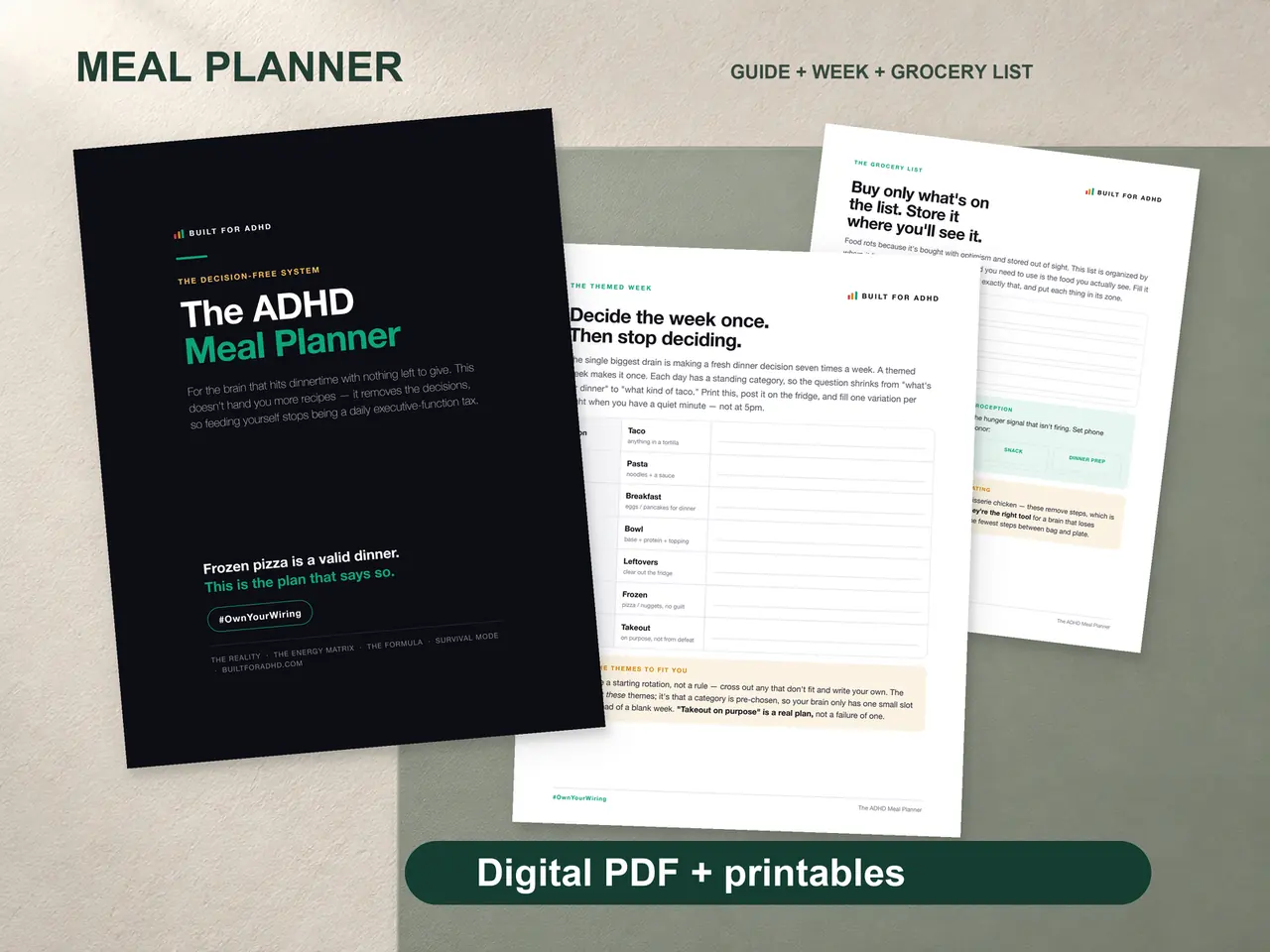
If you’d rather have the whole food side built — meals sorted by the energy they take, the safe-foods list, the grocery page organized by store section, and the survival-dinners page for the nights you genuinely cannot — that’s the ADHD Meal Planner, $7. The bin and the photo are free and they’re most of the money back either way.
Related tools
- ADHD meal planning template — the planning surface the fridge photo feeds
- The free parent starter set — the fridge-door layout for the week’s plan
- ADHD and forgetting to eat — when the problem is upstream of the fridge
- What to eat when you can’t decide — shrinking the decision to one bin
- AI meal planning for ADHD — turning the shelf photo into a week
- What is the ADHD tax — the other places this money leaks