In this article
There is a notebook in your house with eleven pages filled and two hundred blank. Maybe there are three of them. The first entries are dated within a week of each other, the handwriting is neat, and then there’s a gap of four months and one entry that starts “okay, restarting this.”
I have that notebook. I have the nicer one I bought to replace it, because clearly the first one failed for aesthetic reasons. I have the app with the streak counter that hit nine days and then became a small daily accusation on my home screen until I deleted it.
Here’s what took me embarrassingly long to work out: journaling didn’t fail because I lack discipline. It failed because standard journaling is built on three specific capacities — recall, unstructured output, and unrewarded consistency — and ADHD brains are unreliable at all three. It’s the same structural mismatch that makes every productivity system fail ADHD brains, and once you see it, you can build the version that works. The externalize-everything principle that runs through the ADHD tools for adults that actually stick applies here too — the goal was never a journal. It was getting things out of your head.
The three things journaling quietly requires
1. It asks you to remember your day. “How was today?” is a memory retrieval task, and ADHD working memory doesn’t archive the day in a retrievable format. By 9 PM the meeting that wrecked you at 11 AM is genuinely gone — not repressed, just never filed. So you sit with the pen up and produce “today was fine, tired,” which is both true and useless, and the emptiness of it is what makes you skip tomorrow. You’re not being lazy. You’re being asked to read from a tape that didn’t record.
2. It gives you a blank page. A blank page is the maximum-freedom, maximum-cost format. Every entry starts with an unbounded decision: what do I write about? For a brain that’s already over budget on decisions by mid-afternoon, the blank page arrives at exactly the wrong hour asking exactly the wrong question. Notice that the days you did journal were probably the days something big happened — the topic was pre-selected for you. That’s the tell. It was never about motivation; it was about whether the page came with a prompt attached.
3. It pays you in nothing, later. The pitch for journaling is deferred and abstract: self-knowledge, patterns over time, a record for future you. ADHD brains run on now. A reward six months out doesn’t register as a reward at all, which means every entry is a withdrawal with no deposit. Then the streak counter shows up and turns the whole thing into a thing you can fail at, and eleven days of effort become evidence in a case against yourself — which, if you’ve got RSD, costs more than the notebook ever gave back.
Three requirements, three misses. The notebook was never going to survive that. It’s not a character flaw that it didn’t.
What actually works: dump, don’t reflect
The version that sticks isn’t journaling. It’s brain dumping, and the differences are small on paper and enormous in practice.
A journal asks you to look backward and interpret. A brain dump asks you to empty forward — everything currently circling, unsorted, unpunctuated, ugly. No memory retrieval required, because you’re only writing what’s already loud in your head right now. No blank-page decision, because the instruction is “everything,” which is the one prompt that needs no thinking. And the payoff is immediate: the loops stop circling the second they’re on paper, because your brain can finally stop holding them. That’s a same-minute reward, which is the only kind your dopamine system reliably shows up for.
Here’s the whole practice.
Set a container, not a habit. Two minutes, one page, timer on. Not “every night” — that’s a streak, and streaks break. Do it when the head noise is loud enough that you notice it. Three times a week that actually happen beats seven that guilt you.
Write in fragments. “email sarah. why did that call feel weird. dentist. i’m tired.” That’s a legitimate entry. Complete sentences are a performance for a reader who does not exist. The brain dump method has the full mechanics, but the honest core is: lower the bar until it’s under your feet.
Sort by energy after, not before. Once it’s out, do one pass and mark what’s a task, what’s a feeling, and what’s just weather. Tasks go where tasks go, sorted by what you’ve actually got in the tank rather than by importance. Feelings just needed to be seen. Weather needs nothing at all — half of what circles at night is weather, and naming it as weather is the entire treatment.
Let the mouth do it if the hand won’t. Some nights the pen is the toll booth. Talking the same six things out loud — into a voice note or a chatbot that sorts them for you — produces the same relief with none of the handwriting shame.
Move it before bed if the loops are nocturnal. If your dumping keeps happening at midnight in your head instead of on paper, that’s a wind-down problem wearing a journaling costume. Dump at 9 PM on purpose and the 11:30 replay has less to work with.
The reframe that makes it survivable
Stop thinking of it as a journal you’re keeping and start thinking of it as a place you put things down. You don’t feel guilty about a laundry basket you didn’t use on Tuesday. It’s not a practice, it’s not a discipline, it’s not a record — it’s a surface, and surfaces don’t judge you for the days you walked past them.
Which means there’s nothing to restart. Nothing broke. The page is there tonight the same as it was there in March, and the eleven filled pages in the old notebook aren’t a failure log — they’re eleven times it worked.
Try it tonight, badly: two minutes, fragments only, everything that’s loud. Then close it. The free brain dump sheet is the one-page version if a blank notebook still feels like a demand — it sorts what you dumped in about thirty seconds so the emptying actually lands somewhere.
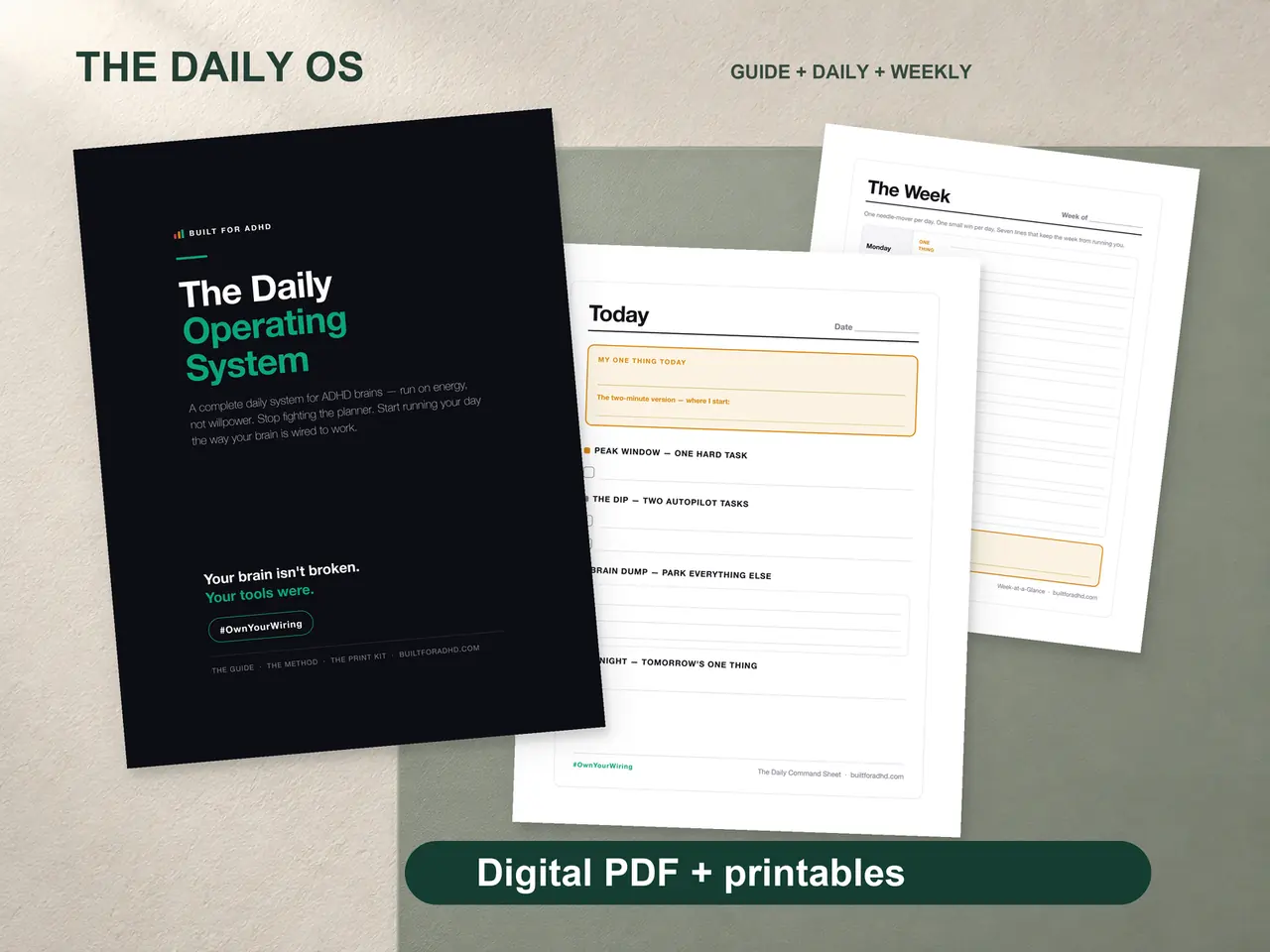
And if the dumping starts working but the next morning still opens with the same fog — the loops are out, and now there are forty of them and no plan — that’s the gap the ADHD Daily Operating System is built for: a morning dump page, the energy sort so you’re not ranking forty items by importance, and a 3-max rule so the day comes out bounded instead of infinite. $17, printable, no streak counter anywhere in it.
Related tools
- ADHD tools for adults — the full externalize-everything toolkit
- The brain dump method — the paper original, in detail
- The free Brain Dump Sorter — triage done for you in 30 seconds
- ADHD Daily Operating System — $17: the dump, sorted and bounded
- Why every productivity system fails ADHD brains — the pattern underneath all of this