In this article
The email arrived three weeks ago. Subject line something like “Action Required: 2027 Benefits Open Enrollment.” You opened it, understood roughly nothing, thought I need an hour and a clear head for this, and closed it.
It is now somewhere in the back half of your inbox, under four hundred other things, and the only reason you’re thinking about it today is that someone mentioned it in a meeting and your stomach dropped.
I have done this. I have done it to the point of submitting at 11:40 PM on the final night with a browser tab open to a glossary, picking whatever had the middle-sized number because I had run out of night. (the forms were fine; the night was not)
Here’s the thing worth saying first: this is not a discipline failure, it’s a task-shape failure. Open enrollment is engineered, almost perfectly, to be invisible to an ADHD brain — and the fix is a checklist, not a better attitude. Visibility is the whole through-line of ADHD money management, and this is the most expensive once-a-year instance of it.
Why this particular task is the worst possible shape
Most annoying admin has one bad quality. This one has four at once.
It’s a hard wall, not a slope. Almost every other deadline in your life is negotiable by a day or two. A late bill costs a fee and an apology. Open enrollment closes, and then it is simply closed — the window is gone until next year. There’s no “I’ll send it tomorrow morning” version. An ADHD brain that doesn’t feel distant deadlines approaching is being asked to respect the single least forgiving one of the year.
Doing nothing is a choice that gets made for you. This is the part that gets people. Skipping the form doesn’t leave things as they are — depending on where you work, you get rolled into last year’s elections, or dropped to a default, or left with nothing. Inaction has an outcome, and nobody frames it that way in the email. Avoidance usually feels like pressing pause. Here it’s pressing a button.
It’s boring and high-stakes at the same time. Those two usually don’t co-occur. Boring tasks get skipped cheaply; high-stakes tasks generate enough adrenaline to get done. This one is dull enough to avoid and consequential enough that avoiding it costs real money — so you avoid it and carry dread about it, which is the worst available combination.
It’s ambiguous, so it never feels startable. There’s no clear first move. Is the first step reading the plan comparison? Calling someone? Finding last year’s card? When a task has no obvious handle, the brain treats “figure out the first step” as the task and quietly declines to open it.
So: no felt deadline, a punishment for inaction, no dopamine, and no obvious entry point. Of course it’s still sitting there.
The one-sitting checklist
The goal is not to understand your benefits. The goal is to have submitted. Those are different projects and you only have time for the second one.
Six steps, in order, roughly forty minutes. Do them in one sitting if you possibly can — this is a task that gets dramatically worse when split across days, because every restart costs you the twenty minutes of reloading context.
1. Find the actual date and write it somewhere physical. Search your email for “open enrollment” and find the closing date. Not “sometime in November” — the date. Write it on a sticky note on your laptop or your bathroom mirror. The date living only inside an email is the same as the date not existing. If you can’t find it in two minutes, stop searching and ask HR directly; that question takes them nine seconds to answer.
2. Put the appointment in the calendar now, before you feel ready. Pick a block at least four days before the wall, and make it a real event with an alert, not an intention. Four days of buffer is the whole trick — it means one bad evening doesn’t cost you the year. This is reverse-engineering backward from the deadline applied to the one deadline that can’t slip.
3. Gather four things into one place. Before you open the portal: your login (this is where half of all attempts die — reset the password now, not during the session), last year’s elections if you can find them, the names and birthdates of anyone you’re covering, and a single number for roughly what you spent on health care last year. Put them in one note. That’s the gathering done; you don’t need anything else.
4. Decide only the things that are actually decisions. Most of the portal is confirmation clicking. The real decisions are usually: which plan, whether to put money in a tax-advantaged account and how much, and whether your dependents and beneficiaries are still correct. Everything else is “yes, same as before, next.” Naming the three live decisions shrinks the task from a sprawling research project to three questions, and three questions can be finished tonight.
5. Submit before you feel finished. You will not reach the feeling of having optimized this. Nobody does. Make the defensible choice, submit, and let it be done — a submitted imperfect election beats a perfect unsubmitted one by an enormous margin, because the second one is worth nothing.
6. Screenshot the confirmation. Take the confirmation page, screenshot it, and put it somewhere you’d actually look — a photos album, a note titled “benefits,” emailed to yourself. In January you will absolutely not remember what you picked, and the alternative is re-learning it under pressure. Then set a repeating calendar alert for two weeks before the same time next year, titled with what to do, not just what’s happening.
If you already missed it
No lecture. It happens, and it’s one of the biggest single line items in the ADHD tax — not because the amount is dramatic, but because it’s silent and it lasts twelve months.
The only useful move is the uncomfortable one: email HR today and ask, plainly, what your options are. Certain life changes open a window outside the normal period, and the honest answer is that I don’t know which apply to you — but they do know, and asking costs you one email. If sending that email is the actual blocker, that’s a known shape too, and getting the draft out of your head and sent is a separate solvable problem.
To be straight about the limit here: this is a checklist for getting a form submitted on time. It is not advice about which plan or which number is right for you — I’m not qualified to tell you that and neither is anyone who hasn’t seen your situation. Pick the thing you can defend, submit it, and move on with your year.
Where this fits
One submitted form doesn’t fix the machine that lost it. The reason the email disappeared is the same reason bills resurface wearing fees: anything that isn’t visible gets deleted, and the annual stuff is the most invisible of all. If this is a pattern rather than one bad October, the late-fee visibility system is the piece I’d build next, and handing the paperwork pile to an assistant that doesn’t get bored is how the once-a-year forms stop depending on you remembering they exist.
Start free: the adults starter set is the one-page capture sheet that catches things like this on the day the email arrives, instead of three weeks later in a meeting.
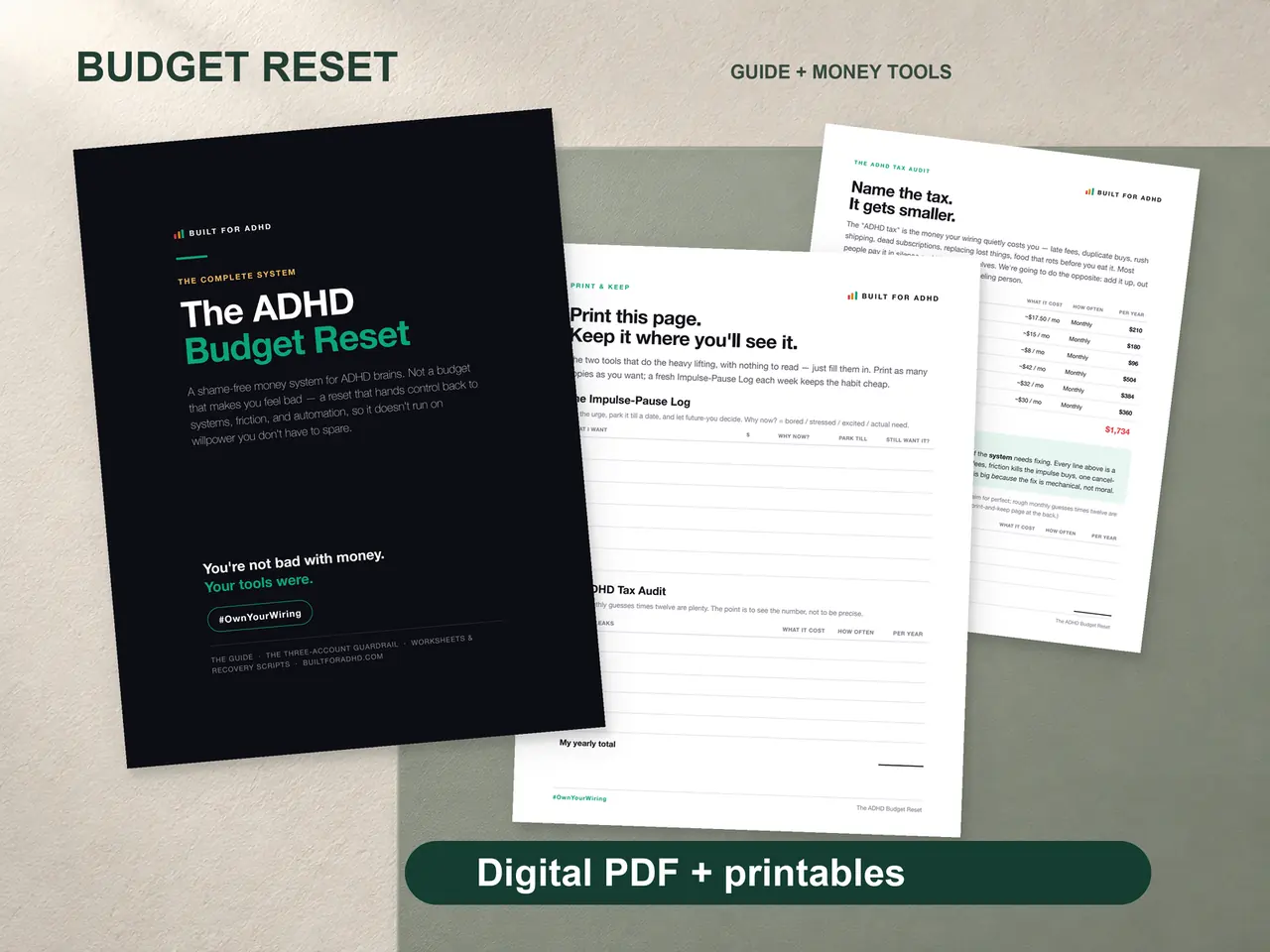
If the money side of this is the part that stings, the ADHD Budget Reset is the system I’d point you at. $7, printable. Honest note: there’s no open-enrollment worksheet inside it — the checklist above is the whole thing and it’s free. What it has is the ADHD Tax Audit for seeing what the missed deadlines actually cost, the three-account guardrail so the bills don’t depend on remembering, and the ten-minute money date that’s short enough to survive a bad week.
Related tools
- ADHD money management — the hub for the money systems that run on visibility
- The adults starter set — a free capture page for the email you’ll otherwise lose
- ADHD late fees and forgotten bills — the visibility fix for everything with a due date
- ADHD money avoidance — why not looking feels like pausing
- Meeting deadlines by reverse-engineering — working backward from a wall that won’t move
- What is the ADHD tax — what the silent twelve-month misses add up to
- ADHD paperwork and admin with AI — handing off the forms you keep not opening
- ADHD decision fatigue — why “figure out the first step” becomes the task